
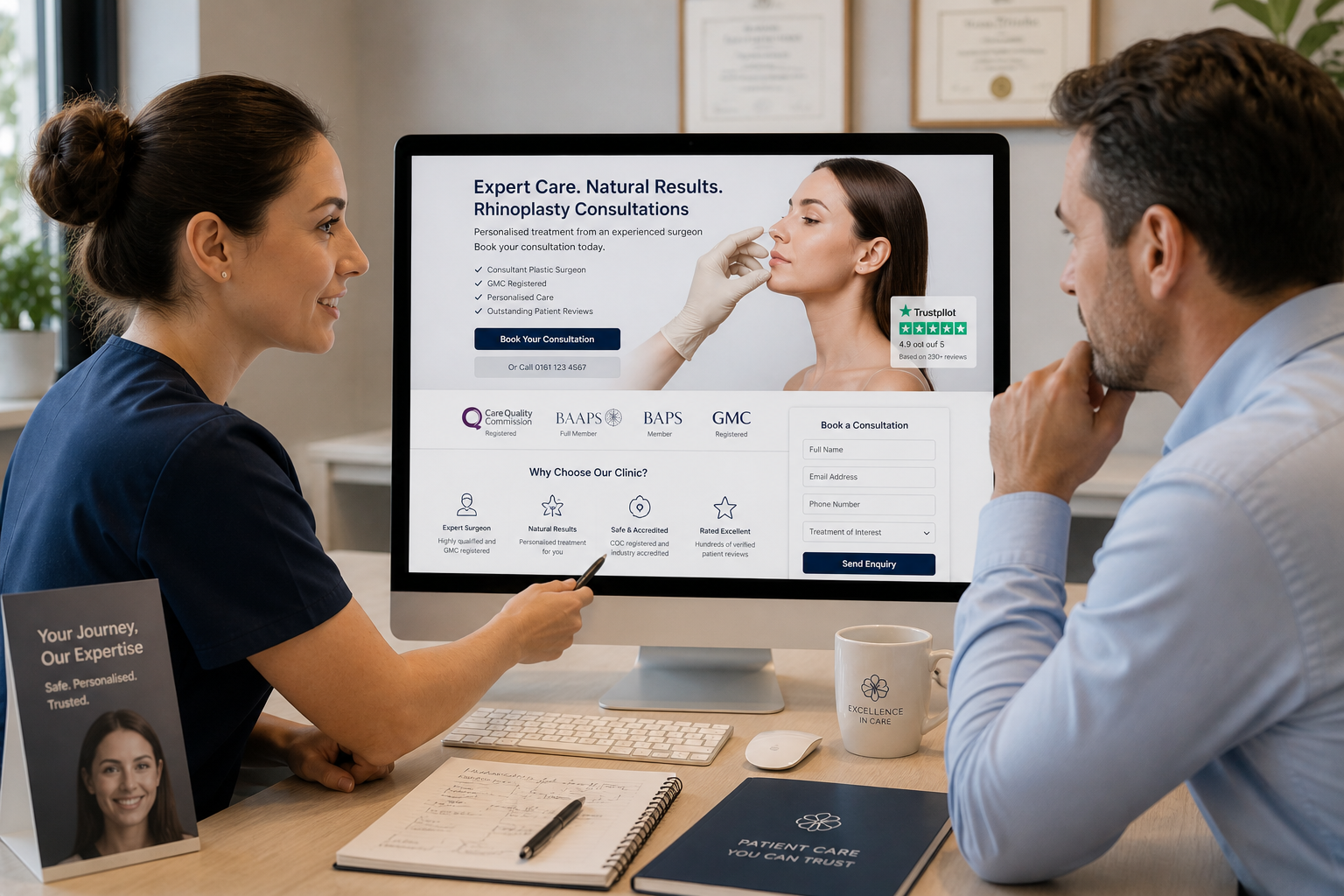
A well-run Google Ads campaign can put your clinic at the top of search results within hours. However, getting the click is only half the job. What happens after the click determines whether that visitor becomes a patient enquiry or simply leaves and finds a competitor.
For most private healthcare clinics, the landing page is where PPC budget is either justified or wasted. Even campaigns with strong keyword targeting and compliant ad copy will underperform if the page a visitor lands on does not build trust, answer the right questions, and make it straightforward to get in touch.
This guide covers the core principles of healthcare landing page optimisation and what private clinics need to get right to turn paid traffic into a consistent stream of qualified patient enquiries.
Why Landing Pages Matter More in Healthcare Than in Other Sectors
In most industries, a reasonable landing page will convert a meaningful proportion of paid traffic. In private healthcare, the bar is higher. Patients making decisions about surgical procedures, fertility treatment, or cosmetic interventions are not impulse buyers. They arrive with questions, concerns, and a high degree of scepticism about marketing claims.
Furthermore, Google’s YMYL guidelines mean that healthcare content faces additional scrutiny. A landing page that feels thin, overly promotional, or lacking in clinical credibility will fail both patients and search engines. The page must do genuine work: informing, reassuring, and guiding the visitor towards an enquiry.
The result is that landing page quality has a direct impact on two separate outcomes. First, it determines whether a PPC visitor converts into an enquiry. Second, it influences Google’s Quality Score for your ads, which affects how much you pay per click and how prominently your ads are displayed. A high-quality, relevant landing page reduces cost-per-click and improves ad position simultaneously.
The Most Common Landing Page Mistakes Private Clinics Make
Before covering what works, it helps to understand what consistently fails. These are the landing page mistakes that cost private clinics the most in wasted PPC budget.
Sending all traffic to the homepage
The homepage of a private clinic serves many audiences simultaneously. It introduces the clinic, lists services, explains the team, and provides general information. For a patient who has just searched for a specific procedure and clicked a targeted ad, landing on a generic homepage creates immediate friction. They must now find the relevant information themselves, and most will not bother.
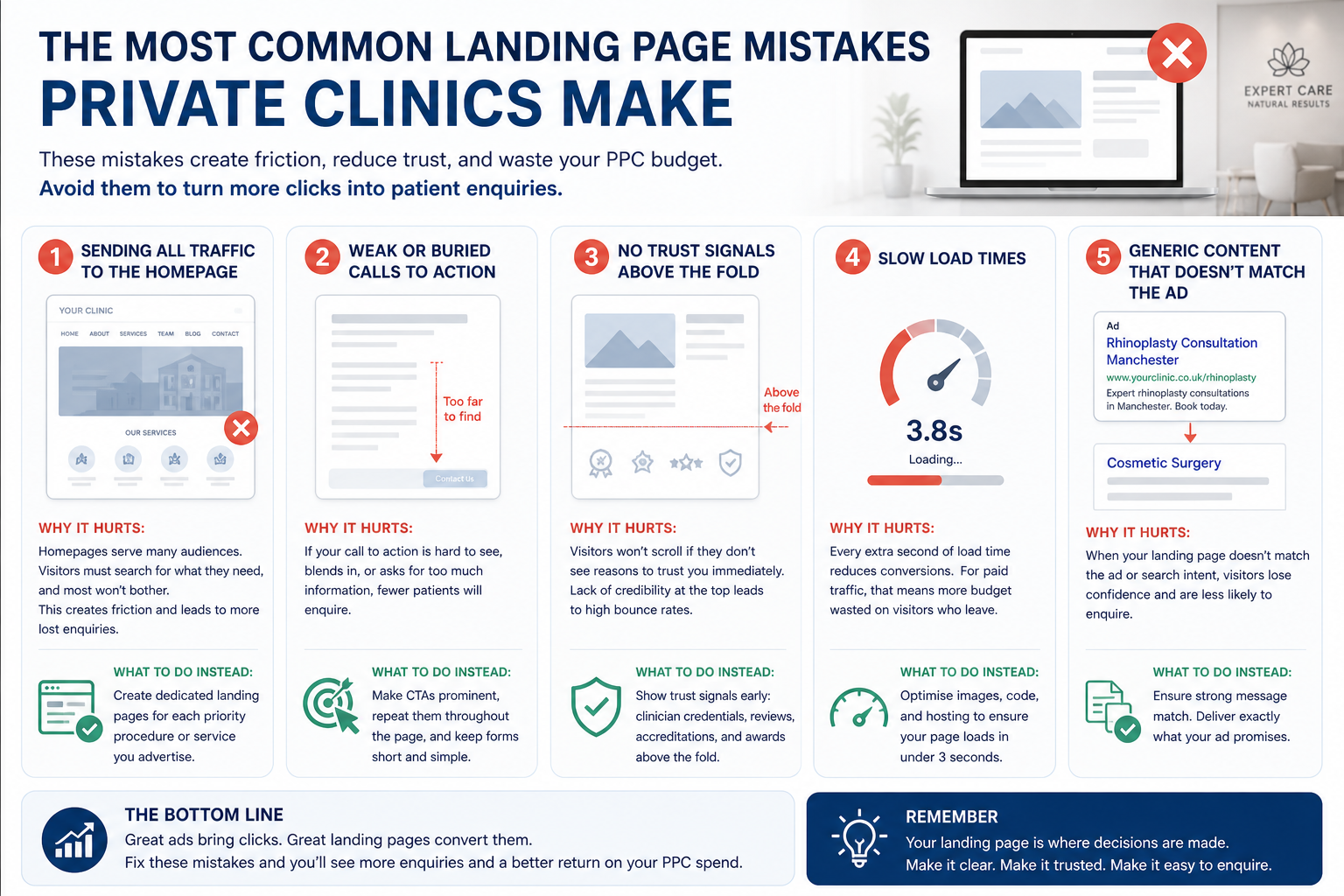 Every priority procedure or service being advertised should have its own dedicated landing page. This is one of the most consistent improvements available to clinics running healthcare PPC campaigns.
Weak or buried calls to action
Many clinic landing pages include a call to action somewhere on the page, but it requires scrolling to find it, it is visually understated, or it asks for too much information. A patient who has decided to enquire should never have to work to find out how. The call to action must be prominent, repeated, and frictionless.
No trust signals above the fold
The section of a landing page visible before scrolling, known as above the fold, is the most important real estate on the page. If it does not immediately communicate credibility, a significant proportion of visitors will leave without reading further. Clinics that lead with a generic hero image and a headline with no trust signals are losing patients at the first moment of evaluation.
Slow load times
Page speed has a direct and well-documented impact on conversion rates. Every additional second a page takes to load reduces the proportion of visitors who stay and engage. For paid traffic, where each click costs money, a slow page is an expensive problem. Our guide on how page speed affects patient enquiries covers the specific impact on private healthcare clinics in detail.
Generic content that does not match the ad
Message match is one of the most important principles in paid search. When a patient clicks an ad for “rhinoplasty consultation Manchester”, they expect to land on a page specifically about rhinoplasty consultations, ideally with a Manchester reference. If instead they land on a general cosmetic surgery page, the disconnect creates doubt and reduces conversion rates significantly.
The Essential Elements of a High-Converting Healthcare Landing Page
The following elements are present on consistently high-performing landing pages for private healthcare clinics. Not every page will include all of them, but the more of these elements are in place, the higher the conversion rate tends to be.
A procedure-specific headline that matches the ad
The headline is the first thing a visitor reads and the primary factor in whether they stay. It must immediately confirm that they have landed in the right place. If the ad said “Breast Augmentation Consultations | Book Today”, the landing page headline should reflect that directly. A mismatch between ad and page headline is one of the fastest ways to lose a qualified visitor.
Surgeon or clinician credentials presented prominently
Private healthcare patients are choosing who will treat them, not just which clinic to attend. Presenting the treating clinician’s qualifications, GMC registration, professional memberships, and relevant experience prominently on the landing page addresses one of the patient’s primary concerns before they need to ask. This is also a direct E-E-A-T signal that benefits both conversion and organic performance.
Verified patient reviews and testimonials
Social proof is one of the most powerful conversion tools available to private clinics. Verified reviews from platforms such as Trustpilot, Google, or Doctify carry more weight than testimonials presented on the clinic’s own website, because patients understand they are independently verified. Where possible, include procedure-specific reviews on procedure-specific landing pages.
Clear, balanced procedure information
Patients arriving at a landing page from a paid search ad are typically in the consideration phase of their decision. They are not yet ready to book. They are evaluating whether this clinic and this procedure are right for them. A landing page that provides clear, honest, and balanced information about the procedure, including realistic outcomes, recovery expectations, and potential risks, builds the trust that moves a visitor from consideration to enquiry.
This approach also aligns with Google’s E-E-A-T requirements for YMYL content. Pages that present balanced clinical information consistently outperform those that read as purely promotional.
A prominent and simple enquiry form
The enquiry form is where conversion happens. It should be visible without scrolling on desktop, or very close to the top of the page on mobile. It should ask for the minimum information needed to respond to the enquiry, typically name, phone number or email, and the treatment of interest. Every additional field reduces conversion rate. Ask only for what is genuinely necessary at this stage.
A click-to-call button for mobile visitors
A significant proportion of private healthcare searches happen on mobile devices, and many patients prefer to call rather than complete a form. A prominently placed click-to-call button removes a step from the conversion process for these visitors and can meaningfully increase overall enquiry volume from mobile traffic.
Accreditation and regulatory badges
CQC registration, BAAPS or BACS membership, hospital group affiliations, and similar accreditations all serve as trust signals that reassure patients about the quality and safety of care. Displayed visibly on the landing page, these signals address concerns that patients may have but will not always verbalise.
Page Structure and Layout for Healthcare Landing Pages
The order in which information is presented on a landing page matters. Visitors scan before they read, and the structure of the page determines what they absorb in the first few seconds.
A high-performing structure for a private healthcare procedure landing page typically follows this sequence:
- Above the fold: Procedure-specific headline, a brief value statement, surgeon credential reference, and a prominent call to action or enquiry form
- Trust bar: A horizontal strip showing accreditation logos, review platform ratings, and key credentials
- Procedure overview: Clear, balanced information about what the procedure involves, who it is suitable for, and what to expect
- Surgeon or clinician profile: Credentials, experience, and professional memberships presented in detail
- Patient reviews: Verified testimonials specific to the procedure where possible
- FAQ section: Answers to the most common patient questions about the procedure, recovery, cost, and what happens at consultation
- Secondary call to action: A second enquiry form or call-to-action button lower on the page for visitors who read through before deciding to enquire
This structure ensures that whatever stage of the decision a visitor is at when they land, the page provides what they need and consistently directs them towards an enquiry.
Mobile Optimisation for Healthcare Landing Pages
More than half of private healthcare searches now happen on mobile devices. A landing page that works well on desktop but performs poorly on mobile is therefore losing a significant proportion of its potential enquiries.
Mobile optimisation for healthcare landing pages goes beyond responsive design. It requires active decisions about what information is prioritised, how forms are structured, and how calls to action are presented on a smaller screen.
Key mobile optimisation considerations include:
- The call to action or enquiry form must be visible near the top of the page without scrolling
- A click-to-call button should be fixed or prominently placed throughout the page
- Form fields must be large enough to tap accurately on a touchscreen
- Images and videos must not slow page load on mobile connections
- Text must be readable without zooming, with sufficient contrast and spacing
A high-converting healthcare website treats mobile visitors as the primary audience, not an afterthought. For PPC landing pages specifically, mobile performance directly affects both conversion rate and Google Quality Score.
How Landing Pages Connect to Your Wider Digital Strategy
Landing page optimisation does not exist in isolation. The performance of a landing page is connected to the quality of the traffic arriving at it, the strength of the broader website it sits within, and the follow-up process that handles enquiries once they are submitted.
From a healthcare SEO perspective, well-structured procedure landing pages also support organic rankings. A page built for PPC conversion, with clear procedure information, clinical credentials, and structured content, is also a strong candidate for organic search visibility. In many cases, the same page can serve both paid and organic traffic effectively.
Similarly, the content approach on landing pages should be consistent with the broader healthcare website content strategy for the clinic. Inconsistency between landing page messaging and the rest of the site creates doubt in patients who explore beyond the initial page.
For clinics running both PPC and SEO simultaneously, coordinating landing page development across both channels ensures that investment in page quality benefits multiple traffic sources rather than just one.
Measuring Landing Page Performance
Optimisation is an ongoing process, not a one-time task. To improve landing page performance over time, clinics need to measure what is and is not working.
The most important metrics for healthcare landing pages are:
- Conversion rate: The percentage of visitors who submit an enquiry form or make a call. This is the primary measure of landing page effectiveness.
- Bounce rate: The percentage of visitors who leave without taking any action. A high bounce rate on a PPC landing page indicates a disconnect between the ad and the page, or a trust or usability issue.
- Time on page: Longer time on page generally indicates that visitors are engaging with the content. Very short average times suggest the page is not meeting expectations.
- Cost per enquiry: The total PPC spend divided by the number of enquiries generated. This is the metric that connects landing page performance directly to return on investment.
- Form abandonment rate: If visitors reach the form but do not complete it, the form itself may have too many fields, unclear labels, or a technical issue.
Regular review of these metrics, combined with ongoing testing of headlines, calls to action, form structure, and page layout, is what drives sustained improvement in enquiry volume from paid traffic. For a broader view of how to measure healthcare marketing ROI, our dedicated guide covers the full measurement framework.
Landing Page Optimisation as Part of a PPC Strategy
The most effective healthcare PPC campaigns treat landing page quality as an integral part of campaign strategy, not a separate concern. Keyword selection, ad copy, and landing page content should all be aligned around the same patient intent and the same conversion goal.
When these elements work together, the result is a campaign that not only generates clicks but converts those clicks into qualified enquiries at a predictable and measurable cost. This is the difference between PPC that drains budget and PPC that drives genuine patient acquisition.
For clinics considering PPC for specific procedure categories, landing page quality is one of the first areas we assess and address before any significant budget is committed. It is also one of the highest-return investments a clinic can make in its digital marketing infrastructure.
FAQs: Healthcare Landing Page Optimisation
Do I need a separate landing page for every procedure?
For procedures you are actively advertising with PPC, yes. Each procedure should have its own dedicated page that matches the specific search intent of the ad. Sending multiple procedure campaigns to the same generic page consistently underperforms compared to dedicated pages. Over time, well-structured procedure pages also support organic SEO rankings for those procedures.
How many fields should my enquiry form have?
As few as possible while still capturing what you need to respond. For most private healthcare clinics, name and either a phone number or email address is sufficient at the initial enquiry stage. Treatment of interest can also be useful if you offer multiple services. Every additional field reduces conversion rate. Additional information can be gathered during the follow-up call or consultation.
How important is page speed for PPC landing pages?
Extremely important. Google’s research indicates that conversion rates drop significantly with each additional second of load time. For paid traffic, where you are paying for every visitor, a slow page is directly costing you enquiries. Our guide on how page speed affects patient enquiries covers the specific data and what to do about it.
Should my landing page look different from the rest of my website?
It should feel consistent with your wider brand while being optimised for conversion. Removing navigation menus from PPC landing pages is a common practice, as it keeps visitors focused on the enquiry rather than browsing elsewhere on the site. However, the visual style, tone, and trust signals should be consistent with the overall clinic website.
How do I know if my landing page is performing well?
The primary indicator is conversion rate, specifically what percentage of paid visitors submit an enquiry. Industry benchmarks vary by procedure and market, but a well-optimised healthcare landing page should convert between 5 and 15 percent of paid traffic into enquiries. If your conversion rate is significantly below this range, there is almost certainly room to improve through structural, content, or technical changes.
Can the same landing page work for both PPC and organic traffic?
In many cases, yes. A page built around clear procedure information, clinical credentials, and a strong call to action serves both paid and organic visitors effectively. The main consideration is ensuring the page is optimised for the relevant search terms from an SEO perspective as well as being structured for conversion. When both are done well, a single page can generate enquiries from multiple traffic sources simultaneously.
Need Help Improving Your Healthcare Landing Pages?
Nexus Healthcare builds and optimises landing pages specifically for private healthcare providers. We work across PPC campaign management, website development, and healthcare SEO, which means every landing page we build is designed to perform across all three channels.
If your current landing pages are not converting paid traffic into patient enquiries at the rate you need, get in touch with the Nexus Healthcare team to discuss how we can help.
