
Most private clinics know they need digital marketing. Fewer know how to evaluate the agencies offering it. The healthcare market is full of generalist agencies that claim healthcare experience but lack the clinical knowledge, compliance awareness, and sector-specific strategy that private providers actually need.
Choosing the wrong agency is expensive in more than one way. It costs budget, time, and often ranking positions that take months to recover. Choosing the right one, on the other hand, can transform a clinic’s online visibility, enquiry volume, and patient acquisition within a relatively short period.
This guide sets out exactly what private clinics should look for when choosing a healthcare digital marketing agency, and the questions to ask before signing any contract.
Why Healthcare Marketing Is Different
Digital marketing for private healthcare is not the same as marketing for retail, hospitality, or professional services. Several factors make it a genuinely specialist discipline.
 YMYL and E-E-A-T compliance
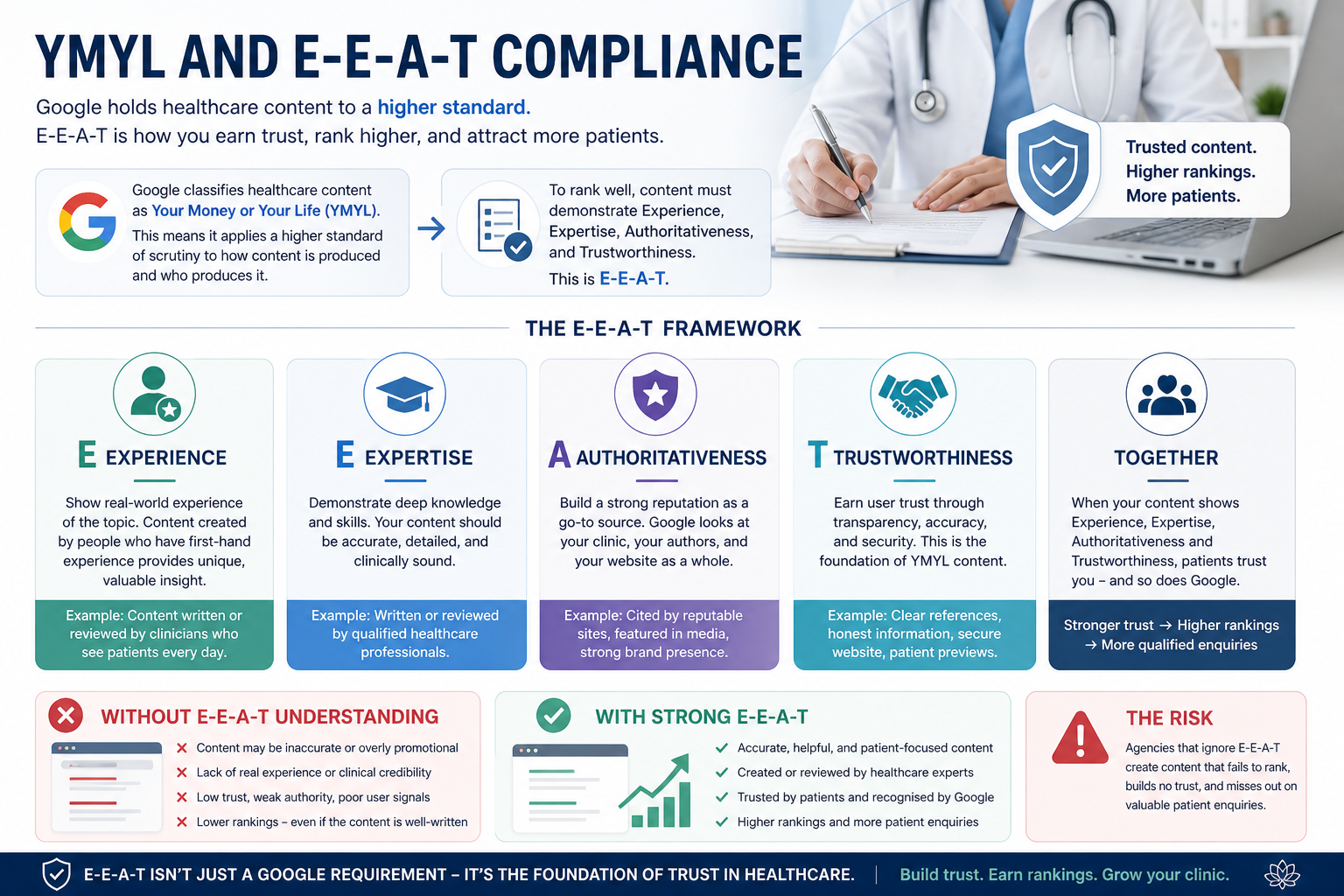
Google classifies healthcare content as Your Money or Your Life (YMYL), meaning it applies a higher standard of scrutiny to how content is produced and who produces it. To rank well, content must demonstrate Experience, Expertise, Authoritativeness, and Trustworthiness, commonly referred to as E-E-A-T. An agency that does not understand E-E-A-T will produce content that fails to rank, regardless of how well-written it appears.
Advertising regulations
Healthcare advertising in the UK is governed by ASA and CAP guidelines, as well as platform-specific rules on Google and Meta. Ads for certain treatments require specific wording, cannot make outcome claims, and in some cases require prior certification. An agency unfamiliar with these rules will produce ads that get suspended or, worse, generate regulatory complaints.
Patient intent and the research journey
Private healthcare patients do not convert quickly. They research extensively, compare providers, read reviews, and often take weeks or months before making an enquiry. A marketing strategy built around fast-conversion consumer behaviour will underperform in this context. Effective healthcare SEO and paid search must reflect the longer, more considered patient journey.
Clinical sensitivity
Content about surgical procedures, medical conditions, and treatment outcomes must be accurate, balanced, and written with appropriate care. Agencies without healthcare experience routinely produce content that oversimplifies risks, makes unsubstantiated claims, or uses language that would concern a clinician. This damages trust and creates compliance risk.
The Key Things to Look for in a Healthcare Marketing Agency
1. Exclusive or significant healthcare focus
An agency that works across multiple unrelated industries is unlikely to have the depth of healthcare knowledge your clinic needs. Look for agencies where healthcare is a core specialism, not one vertical among many. Ask what proportion of their clients are in the private healthcare sector and request specific examples of comparable work.
2. Demonstrable SEO results in healthcare
Any agency can claim SEO expertise. Ask to see real examples of healthcare SEO results, including ranking improvements, traffic growth, and enquiry data for comparable clients. Be cautious of agencies that show rankings for low-competition terms or traffic increases that do not correlate with enquiry growth.
3. Understanding of PPC compliance in healthcare
If the agency manages paid advertising, they must understand the specific rules governing healthcare PPC. Ask how they handle Google’s healthcare advertising certification requirements, how they approach ad copy compliance for regulated treatments, and what their process is for avoiding account suspension.
4. Content produced by people with healthcare knowledge
Ask directly who writes the content and what their background is. Healthcare website content that ranks well and converts patients must be accurate, clinically credible, and written in a way that reflects how patients think and search. Generic content writers without healthcare knowledge consistently produce material that fails on both counts.
5. A strategy-first approach
Avoid agencies that lead with deliverables rather than strategy. The number of blog posts per month or the volume of backlinks built matters far less than whether those activities are part of a coherent plan aligned to your clinic’s growth objectives. A good agency will want to understand your services, locations, patient profile, and competitive landscape before proposing any activity.
6. Transparent reporting
You should always know what your marketing budget is delivering. Look for agencies that report on metrics that matter to your clinic, specifically enquiry volume, cost per enquiry, and return on investment, not just traffic and impressions. If an agency is reluctant to connect marketing activity to business outcomes, that is a significant concern.
7. Website capability
Many private clinics need ongoing website development alongside their marketing. An agency that can manage healthcare website creation and management alongside SEO and PPC removes the complexity of coordinating multiple suppliers and ensures that technical and content decisions are aligned.
Red Flags to Watch for When Evaluating Agencies
Just as important as knowing what to look for is knowing what to avoid. These are the most common warning signs that an agency is not the right fit for a private healthcare clinic.
- Guaranteed rankings: No agency can guarantee specific Google rankings. Any agency that does is either misleading you or using techniques that risk a Google penalty.
- Vague case studies: Case studies that show traffic increases without enquiry data, or that do not name the client or sector, are difficult to verify and should be treated with scepticism.
- One-size-fits-all packages: Private healthcare clinics have different needs depending on their size, services, locations, and stage of growth. Rigid packages that do not flex to your situation suggest an agency that processes clients rather than serves them.
- No mention of compliance: If an agency pitches healthcare marketing without mentioning ASA, CAP, YMYL, or E-E-A-T, they almost certainly do not understand the regulatory environment well enough to operate safely in it.
- Outsourced content production: Content farms and offshore writing teams are common in agencies that compete on price. For YMYL healthcare content, this approach consistently underperforms and creates compliance risk.
- Slow communication: If an agency is slow to respond during the sales process, they will be slow to respond when you are a client. Responsiveness is a reliable indicator of how an agency operates day to day.
Questions to Ask Before Appointing a Healthcare Marketing Agency
Before signing any agreement, ask these questions directly and evaluate the answers carefully.
- What proportion of your clients are in private healthcare, and can you share specific examples?
- Who writes your healthcare content, and what is their background?
- How do you approach E-E-A-T compliance for YMYL content?
- How do you handle compliance for healthcare PPC campaigns on Google and Meta?
- What metrics do you report on, and how do you connect marketing activity to enquiry generation?
- Do you manage website development alongside marketing, or would we need a separate supplier?
- What does your onboarding process look like, and how long before we see initial results?
- How do you approach strategy, and how often do you review and adapt it?
A strong agency will answer these questions clearly and confidently. Vague or deflective answers to any of them are worth taking seriously.
The Difference Between a General Agency and a Healthcare Specialist
To illustrate why specialism matters, consider how a general agency and a healthcare specialist approach the same task differently.
Writing a blog post about rhinoplasty
A general agency will produce a blog post optimised for keyword density, written by a content writer with no medical background. It will likely contain inaccuracies, make unsubstantiated claims about results, and fail Google’s E-E-A-T assessment for YMYL content. As a result, it will rank poorly and may create compliance risk.
A healthcare specialist will produce content that reflects real patient questions, presents balanced and accurate clinical information, references appropriate professional credentials, and is structured to meet Google’s E-E-A-T requirements. The result is content that ranks, converts, and builds long-term trust.
Running a Google Ads campaign for a cosmetic procedure
A general agency will build a campaign around high-volume keywords with broad match targeting, produce ad copy focused on clicks, and send traffic to a generic homepage. The campaign will generate traffic but few qualified enquiries, and the ad copy may violate healthcare advertising guidelines.
A healthcare specialist will build the campaign around procedure-specific, high-intent keywords, write compliant ad copy that reflects how patients search and decide, and direct traffic to dedicated landing pages optimised for enquiry conversion. For more on this, see our guide to PPC for cosmetic surgery clinics.
What a Full-Service Healthcare Marketing Strategy Looks Like
The most effective approach to private clinic marketing integrates multiple channels into a single coordinated strategy. Rather than running SEO, PPC, and content as separate activities, a specialist agency will align them around shared goals and a consistent understanding of your patients, services, and competitive position.
A comprehensive healthcare digital marketing strategy for a private clinic typically includes:
- SEO: Building organic visibility for priority services and locations through technical optimisation, content, and authority building. See our healthcare SEO strategy guide for a full breakdown.
- PPC: Pay Per Click advertising for immediate visibility, particularly useful for new services, competitive treatments, and location expansion.
- Website: A fast, well-structured, high-converting healthcare website that supports both organic and paid traffic.
- Content: Clinically credible, E-E-A-T-compliant content that answers patient questions, builds trust, and supports ranking.
- Tracking and reporting: Clear measurement of enquiry volume, cost per enquiry, and return on investment across all channels.
When these elements work together, the result is a measurable, sustainable system for patient acquisition rather than a collection of disconnected marketing activities.
Why Private Clinics Choose Nexus Healthcare
Nexus Healthcare works exclusively with private healthcare providers. Our clients include private clinics, consultants, surgical practices, and multi-location healthcare brands across the UK and internationally. Every member of our team works in healthcare marketing day to day, which means our SEO, PPC, content, and website work is informed by genuine sector knowledge.
We take a strategy-first approach to every client relationship. Before any work begins, we analyse your services, locations, competitive landscape, and current digital performance. From there, we build a plan aligned to your growth objectives, with transparent reporting that connects every activity to enquiry generation and return on investment.
If you want to understand what this looks like in practice, our healthcare SEO benefits and ROI guide sets out how we measure and demonstrate results for private healthcare clients.
FAQs: Choosing a Healthcare Digital Marketing Agency
How do I know if an agency genuinely understands healthcare?
Ask to see specific examples of healthcare clients they have worked with, the results achieved, and who produces their content. An agency with genuine healthcare expertise will answer these questions confidently and in detail. Vague references to “healthcare experience” without supporting evidence should be treated with caution.
Should I use a specialist healthcare agency or a general agency?
For private healthcare, a specialist is almost always the better choice. The compliance requirements, content standards, and patient acquisition dynamics in private healthcare are sufficiently different from other industries that a general agency will typically underperform. The cost of poor compliance or ineffective content is also higher in healthcare than in most other sectors.
How long does it take to see results from healthcare digital marketing?
PPC can generate enquiries within days of campaigns going live. Healthcare SEO typically takes three to six months to show meaningful ranking improvements, with stronger results building over time as authority grows. A realistic agency will set honest expectations rather than promise fast results across all channels.
What should a healthcare marketing agency report on?
At a minimum, monthly reporting should cover organic traffic and ranking movements, PPC spend and cost per enquiry, enquiry volume by channel, and conversion rates for key landing pages. Agencies that report only on traffic and impressions without connecting these to enquiry generation are not providing the information you need to evaluate return on investment.
Can one agency handle SEO, PPC, and website management?
Yes, and for most private clinics this is the preferred arrangement. A single agency managing all three channels can align strategy across them, ensure technical and content decisions support each other, and provide a single point of accountability for overall digital performance. Coordinating multiple specialist suppliers introduces complexity and often results in misaligned activity.
How do I evaluate the cost of a healthcare marketing agency?
The most useful frame is return on investment rather than monthly cost. An agency charging more but generating a consistent pipeline of qualified enquiries will almost always deliver better value than a cheaper alternative producing activity without measurable results. Ask any agency you are considering to explain how they would measure and demonstrate ROI for your specific clinic.
Ready to Work with a Healthcare Marketing Specialist?
Nexus Healthcare works exclusively with private healthcare providers across the UK. If you are looking for an agency that understands your sector, your patients, and your growth objectives, we would welcome the opportunity to discuss your clinic’s digital marketing needs.
To find out more about how we work and what we can deliver for your clinic, get in touch with the Nexus Healthcare team today.
