Most private clinic websites have the same problem. They look professional. They rank reasonably well. But they do not convert.
Visitors arrive, browse briefly, and leave without enquiring. The clinic has paid to attract that traffic, through SEO, PPC, or both, and nothing comes of it.
The difference between a website that converts and one that does not is rarely about aesthetics. It is about structure, trust, and clarity. This guide breaks down exactly what high-converting private healthcare websites get right.
The Job of Your Website Is Not to Impress. It Is to Convert.
Many clinic websites are designed to look impressive. Clean layouts, professional photography, and polished branding are all valuable. But they do not, on their own, convert visitors into patients.
A high-converting healthcare website does one thing above all else. It removes doubt quickly and makes the next step obvious.
Patients arrive with questions. They want to know if you treat their condition. They want to know what the process looks like. They want to know if they can trust you. And they want to know how to get in touch.
Every page on your website should answer those questions before the patient loses confidence and leaves.
Clear and Specific Service Pages
Vague service pages are one of the most common conversion killers on private healthcare websites.
A page titled “Cosmetic Surgery” that lists ten procedures in a short paragraph does not give a patient enough information to commit to an enquiry. They need to feel informed before they feel confident enough to act.
High-converting service pages do the following:
- Focus on one procedure or treatment per page
- Explain clearly who the treatment is for
- Describe the process, recovery, and realistic outcomes honestly
- Include clinical credentials of the practitioner performing the treatment
- Answer the questions patients typically ask before they have to ask them
- End with a clear, specific call to action
Specific pages also perform significantly better in search. A dedicated page for “rhinoplasty London” or “private cataract surgery Chesterfield” targets the exact intent of a patient ready to enquire.
For more on how content structure supports both rankings and enquiries, see our Healthcare SEO Strategy guide.
Trust Signals Placed Where Patients Are Making Decisions
Trust is the single biggest conversion factor in private healthcare. Patients are not buying a product they can return. They are making a decision about their body and their health.
Trust signals need to appear at the exact points where patients are deciding whether to continue or leave. That means they belong on service pages and near calls to action, not only on an about page that most visitors never reach.
The trust signals that move the needle most for private clinics include:
- Named clinician credentials with GMC or professional body registration numbers
- Verified patient reviews, ideally pulled live from Google or Trustpilot
- Before and after imagery with realistic, honest presentation
- Membership logos for relevant professional bodies such as BAAPS, BAPRAS, or Royal Colleges
- Media coverage or accreditation badges from recognised organisations
- Clear, transparent pricing or at minimum a realistic guide price range
These signals do not just support SEO through E-E-A-T. They directly reduce the hesitation that stops patients from hitting the enquiry button.
For a deeper look at why trust signals matter to Google as well as patients, read our guide on What Google’s YMYL Guidelines Mean for Private Healthcare Websites.
A Conversion Path That Is Obvious on Every Page
Many clinic websites make patients work too hard to enquire. Contact details are buried in the footer. The enquiry form lives on a single page that requires multiple clicks to find.
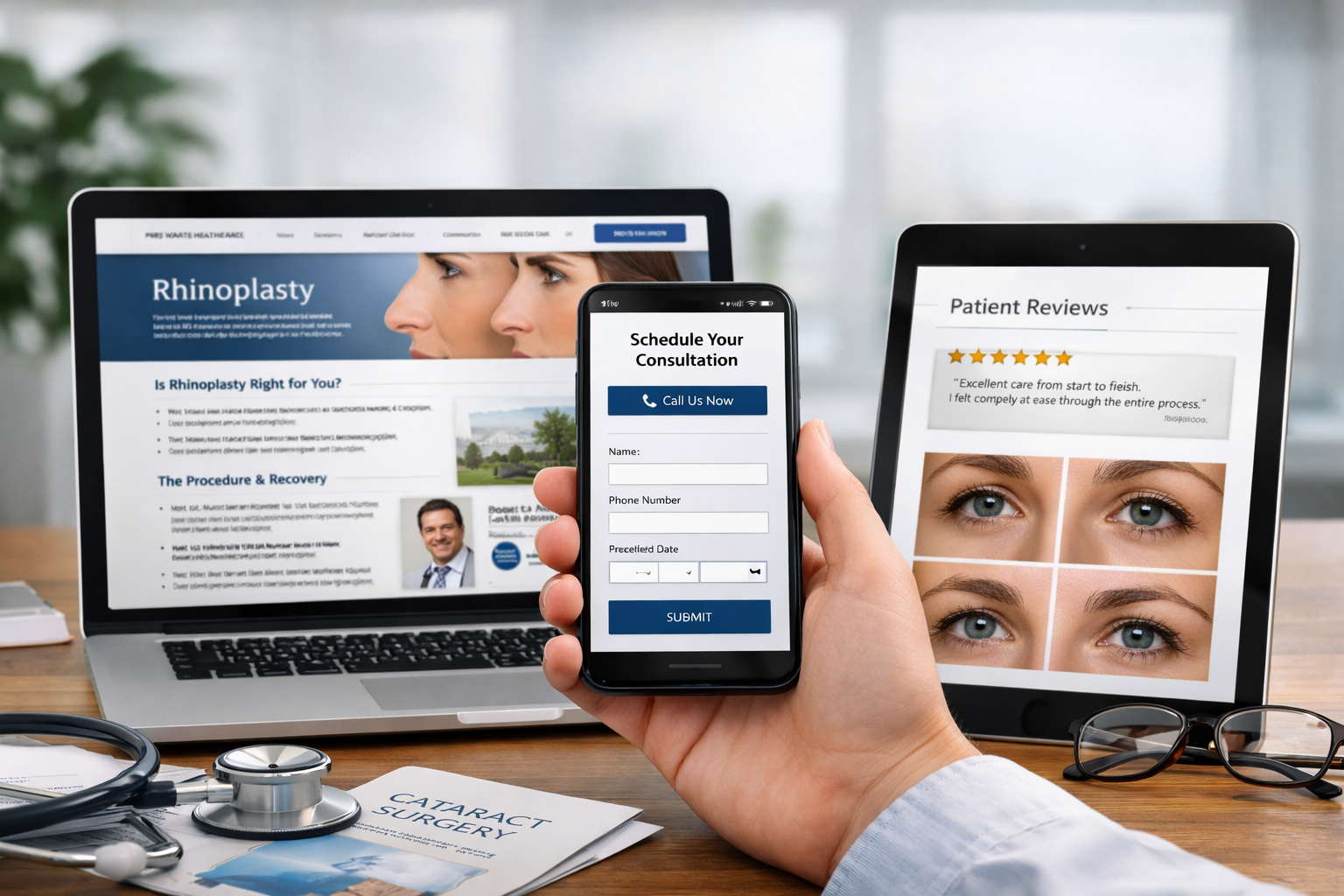
A high-converting healthcare website makes the next step obvious from every page on the site.
That means:
- A prominent phone number or click-to-call button visible in the header on all devices
- A clear CTA above the fold on every service page, not just at the bottom
- A short, low-friction enquiry form that asks for minimal information upfront
- Multiple contact options, phone, form, and where appropriate live chat or WhatsApp
- Booking or consultation CTAs that are specific, not generic (“Book a Free Consultation” performs better than “Contact Us”)
Friction kills conversions. Every additional step between a patient’s interest and their enquiry is an opportunity for them to leave.
Mobile Experience That Actually Works
More than half of all private healthcare website traffic now arrives on a mobile device. A website that works well on desktop but poorly on mobile is losing a significant share of its potential enquiries.
Mobile conversion problems are often subtle. Pages load slowly. Text is too small to read comfortably. CTAs are hard to tap. Forms are difficult to complete on a small screen.
High-converting healthcare websites are designed mobile-first. That means:
- Fast load times on mobile networks, not just desktop broadband
- Tap-friendly buttons and CTAs with adequate spacing
- Readable font sizes without the need to zoom
- Forms that work cleanly on a touchscreen keyboard
- Click-to-call functionality that activates directly from the phone number
Page speed is closely connected to mobile experience and has a direct impact on both conversion rates and search rankings. We cover this in detail in our guide on How Page Speed Affects Patient Enquiries for UK Clinics.
Clinician-Led Content That Demonstrates Real Expertise
Patients researching private healthcare are not passive. They read, compare, and evaluate before they enquire. The clinic whose website provides the clearest, most credible information tends to win the enquiry.
Clinician-led content, whether blog posts, procedure guides, or FAQ sections, serves two purposes at once. It supports SEO by building topical authority. And it builds patient confidence by demonstrating genuine expertise before the first consultation.
This content works best when it is:
- Written or reviewed by the named clinician associated with the service
- Honest about what the treatment involves, including risks and recovery
- Practical and specific rather than generic and promotional
- Structured to answer the questions patients are actually searching for
Generic marketing copy does not build trust. Clinical depth does.
For more on how content quality drives organic performance, see our Healthcare SEO Benefits and ROI guide.
A Homepage That Qualifies and Directs, Not Just Impresses
The homepage is rarely where conversions happen. Its job is to qualify visitors quickly and direct them to the right service page or contact route.
High-converting clinic homepages do this clearly. They establish what the clinic does and who it serves within the first few seconds. They direct different patient types toward the right areas of the site. And they provide an immediate route to enquiry for visitors who already know what they want.
Common homepage mistakes include:
- Leading with a brand statement that tells the visitor nothing specific about services or specialisms
- No clear navigation to individual services above the fold
- A generic hero image with no supporting text that communicates clinical relevance
- No trust signals visible without scrolling
Patients decide within a few seconds whether your website is worth their time. The homepage has to answer the key question fast: is this the right clinic for me?
Internal Linking That Keeps Patients Moving
A well-linked website keeps patients engaged longer. It guides them from an informational page toward a service page, and from a service page toward an enquiry.
Internal links also distribute SEO value across the site. A blog post that links to a relevant service page passes authority to that page and signals topical relevance to search engines.
Every service page should link to related procedures, relevant blog content, and an enquiry route. Every blog post should link to the most relevant service page and at least one other related post.
For an overview of how we approach website design and structure for private clinics, visit our Website Creation and Management page.
Summary: What High-Converting Healthcare Websites Have in Common
The best-performing private healthcare websites are not necessarily the most visually impressive. They share these characteristics:
- Specific, clinically detailed service pages that answer patient questions
- Trust signals placed at the points where decisions are made
- A clear, low-friction conversion path on every page
- A fast, functional mobile experience
- Clinician-led content that builds confidence before the enquiry
- A homepage that qualifies and directs rather than just impresses
- Smart internal linking that guides patients toward action
If your website is attracting traffic but not generating enquiries, the problem is almost always in one of these areas.
Get in touch with Nexus Healthcare to discuss a website audit or a new healthcare website built to convert.
Frequently Asked Questions
What makes a private healthcare website high-converting? A high-converting healthcare website removes doubt quickly and makes the next step obvious. It combines specific service pages, visible trust signals, a clear conversion path, and fast mobile performance. Aesthetics matter, but structure and clarity drive enquiries.
How important are trust signals on a clinic website? Trust signals are among the most important conversion factors in private healthcare. Patients make decisions about their health and their body. Named clinician credentials, verified reviews, professional body memberships, and honest outcome information all reduce hesitation and increase the likelihood of an enquiry.
Why is mobile experience important for clinic websites? More than half of private healthcare website traffic arrives on mobile devices. A slow or poorly structured mobile experience loses a significant share of potential enquiries. Click-to-call functionality, fast load times, and easy-to-complete forms are all essential on mobile.
How does website structure affect SEO for private clinics? Clear service pages, internal linking, and clinician-led content all support search rankings directly. Google rewards websites that demonstrate expertise, trustworthiness, and clear relevance to a patient’s search intent. A well-structured website performs better in both organic search and conversion.
