Most Clinic Websites Have a Content Problem
It is easy to assume that a well-designed website will do the work for you. In practice, design without content strategy produces websites that look professional but fail commercially. They rank for the wrong searches, attract the wrong visitors, and fail to convert the right ones.
A healthcare website content strategy is the plan that connects your clinical services to the patients who are actively searching for them. It determines what each page says, how it structures information, what search intent it serves, and how it moves a visitor toward making an enquiry.
This guide breaks down exactly what every key page type on a private clinic website needs to perform at its best. For a broader introduction to the commercial case for getting this right, our post on healthcare SEO benefits and ROI is a useful starting point.
Why Content Strategy Matters More in Healthcare Than Almost Any Other Sector
Private healthcare sits within Google’s YMYL category, which stands for Your Money or Your Life. This means Google applies its most demanding quality standards to clinic websites. Google actively penalises vague, generic, or clinically inaccurate content in search rankings.
Patients searching for private treatment are making high-stakes decisions. Before parting with significant sums of money, they compare clinics, assess surgeons, and look for reassurance. Your website content must do more than simply exist. It must inform, reassure, and convert.
For a detailed breakdown of what these standards mean in practice, our guide to Google’s YMYL guidelines for private healthcare websites covers the requirements your content is held to.
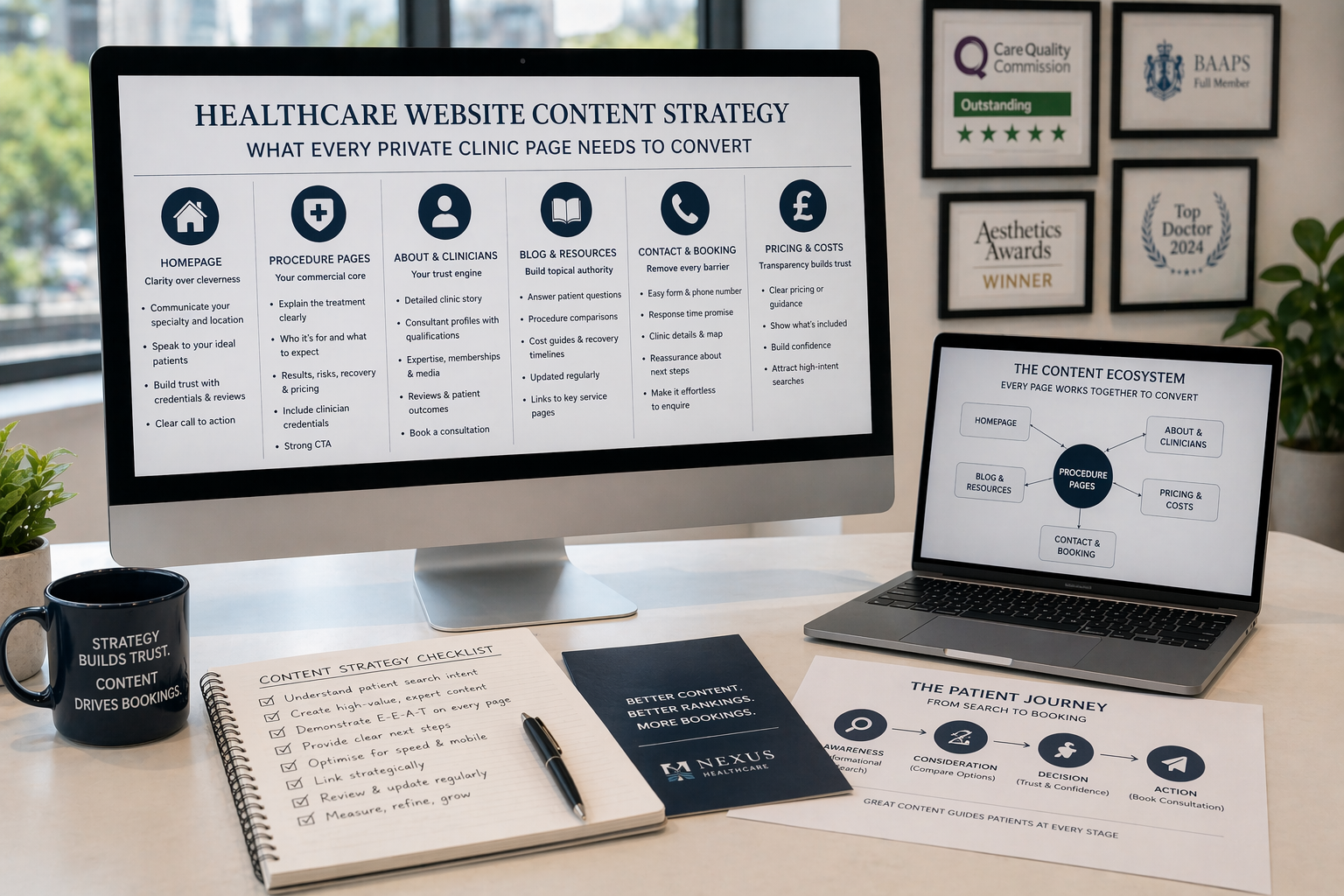
The Homepage: Clarity Over Cleverness
The homepage is the most visited page on most clinic websites. It is also the most commonly misused. Many clinics fill their homepage with vague brand statements and stock imagery, giving visitors no clear signal of what the clinic does or who it serves.
A high-performing healthcare homepage establishes the clinic’s specialty and geographic focus immediately. It signals the types of patients it serves, provides clear navigation to procedure and service areas, and includes trust signals such as accreditations, consultant credentials, and patient reviews. A prominent and frictionless call to action is also essential, whether that is a consultation booking form or a direct phone number.
For a detailed look at what separates high-performing clinic websites from those that underdeliver, our post on what a high-converting private healthcare website actually looks like covers the key elements in full.
Procedure and Treatment Pages: The Commercial Core of Your Website
Procedure pages are where most of your SEO and conversion value lives. Each treatment your clinic offers should have its own dedicated page. Build that page around the search intent of a patient who is actively considering that procedure, not just researching it broadly.
What a Well-Structured Procedure Page Covers
A strong procedure page covers what the treatment involves in plain language, who is a suitable candidate, and what the process looks like from consultation to recovery. Pricing information, realistic outcome expectations, and a clear next step should all feature too.
Clinician credentials matter here as well. Including the qualifications of the team delivering the treatment is not just good practice for conversion. It is a direct E-E-A-T signal that influences how Google ranks the page. Our healthcare SEO strategy guide explains how to build these pages into a wider keyword and content architecture.
The About Page and Consultant Profiles: Your Trust Engine
Many clinics treat the about page as an afterthought. In reality, it is one of the most important pages on the site from both an SEO and a conversion perspective.
Patients choosing a private clinic want to know who will treat them. A strong about page, supported by detailed consultant or practitioner profiles, builds the kind of personal authority that converts browsers into enquiries. Profile pages also attract direct search traffic from patients who have seen a clinician’s name in the press or received a GP referral.
Each profile should include full qualifications and training history, professional memberships and accreditations, areas of specialist interest, and published work or media appearances where relevant. A direct call to action for booking a consultation is essential too. Our guide to SEO for surgeons in the UK covers personal authority building in more depth.
The Blog and Resource Section: Building Topical Authority
A regularly updated blog is not just a content marketing exercise. It is an SEO infrastructure investment. Each well-researched article expands your topical authority, creates additional entry points for organic search traffic, and gives AI tools content to draw on when generating responses about your specialty area.
Effective healthcare blog content addresses the questions patients ask before they book. Procedure comparisons, cost guides, recovery timelines, and candidacy assessments all target high-intent informational searches that sit just above the booking decision in the patient journey.
Over a twelve-month period, a clinic with a strong content programme will typically outrank one with a better-designed but thinner website. Our SEO for private clinics complete guide covers content strategy as part of a broader SEO framework.
The Contact and Booking Page: Remove Every Barrier
The contact page is where conversions either happen or are lost. Many clinic websites provide a single generic form with no indication of response times, no prominent phone number, and no reassurance about next steps.
A high-converting contact page makes every path to enquiry clear and easy. Minimal form fields, a direct phone number, an email address, clinic hours, and location information should all be present. A brief note on what happens after enquiry also helps. Something like “We aim to respond within two hours during working hours” reduces uncertainty and lifts conversion rates.
If your clinic relies heavily on paid traffic to drive contact page visits, our comparison of Google Ads vs Meta Ads for private clinics is worth reading alongside this guide.
Pricing and Cost Pages: Transparency Builds Trust
Many private clinics avoid publishing pricing information, fearing it will put patients off or invite comparisons. In practice, the opposite is true. Patients who cannot find pricing on your website will simply find it on a competitor’s.
A dedicated pricing page or clear cost guidance on each procedure page signals transparency and builds trust. It also attracts high-intent searches from patients comparing treatment costs, which sits among the strongest commercial intent in private healthcare search.
Page Speed and Technical Performance: The Foundation Everything Sits On
Content strategy cannot deliver its full value on a slow or technically flawed website. If pages take more than three seconds to load, a significant proportion of visitors will leave before reading a single word.
Technical performance is not separate from content strategy. Think of it as the foundation everything else sits on. Our post on how page speed affects patient enquiries for UK clinics covers the specific impact slow load times have on private healthcare conversion rates.
Internal Linking: The Architecture That Holds It All Together
A healthcare website content strategy is not just about individual pages. It is about how those pages connect and reinforce one another. A strong internal linking structure pushes authority from high-traffic blog content down to commercial procedure pages, while cross-referencing related treatments in a way that helps both visitors and search engines navigate the site.
In practice, this means every blog post should link to at least one relevant procedure or service page. Procedure pages should point to relevant clinical profiles and supporting resources. Supporting pages should link back to the commercial core of the site.
How Nexus Healthcare Builds Healthcare Content Strategies
At Nexus Healthcare, we build content strategies grounded in commercial intent from the outset. We map search intent across every key page type, audit existing content for E-E-A-T compliance, and develop editorial programmes that build authority in the procedure areas that matter most to each client.
Our website creation and management service combines technical performance with content strategy from the ground up. If your clinic website generates traffic but not enquiries, or simply is not ranking for the searches that matter, a structured content strategy is almost always the solution. Get in touch to find out how we can help.
Frequently Asked Questions
How many pages does a private clinic website need to rank well?
There is no fixed number, but each procedure or service your clinic offers should have its own dedicated page. A clinic offering ten treatments should have at least ten procedure pages, each targeting the specific searches patients make for that treatment. Supporting content such as blog posts, FAQs, and location pages all contribute to overall ranking performance.
Should pricing be included on clinic website pages?
Yes, where possible. Transparent pricing builds trust with patients and attracts high-intent searches from people comparing treatment costs. Clinics that publish pricing guidance consistently outperform those that do not in both search rankings and conversion rates for cost-related queries.
How often should clinic website content be updated?
A named clinician should review clinical content at least annually and update it where guidelines or procedures have changed. Publishing blog content regularly, ideally at least twice a month, signals ongoing expertise to both search engines and AI tools. Any content referencing statistics or external guidelines should be updated whenever those sources change.
What is the most important page on a private clinic website for SEO?
Procedure and treatment pages deliver the most direct commercial SEO value because they target patients who are close to making a booking decision. The homepage, about page, and consultant profiles all play important supporting roles in building the trust and authority that procedure pages rely on to rank effectively.
Does a clinic website need a blog to rank well in search?
A blog is not strictly essential for ranking, but it provides a significant competitive advantage over time. Clinics that publish regular, well-researched content build topical authority faster and attract more organic entry points. In competitive specialties, a strong content programme is often the deciding factor between a clinic that ranks on page one and one that does not.
