Private clinics across the UK are spending more on paid advertising than ever. But many clinic owners still face the same question: where should the budget actually go?
Should it go into Google Ads, Meta Ads, or both? The honest answer depends on your services, your patient journey, and your strategy.
This guide breaks down the key differences, the ROI considerations, and what a smart paid media approach looks like for private healthcare providers.
Understanding the Core Difference: Intent vs Discovery
The most important distinction between Google Ads and Meta Ads is not cost or reach. It is intent.
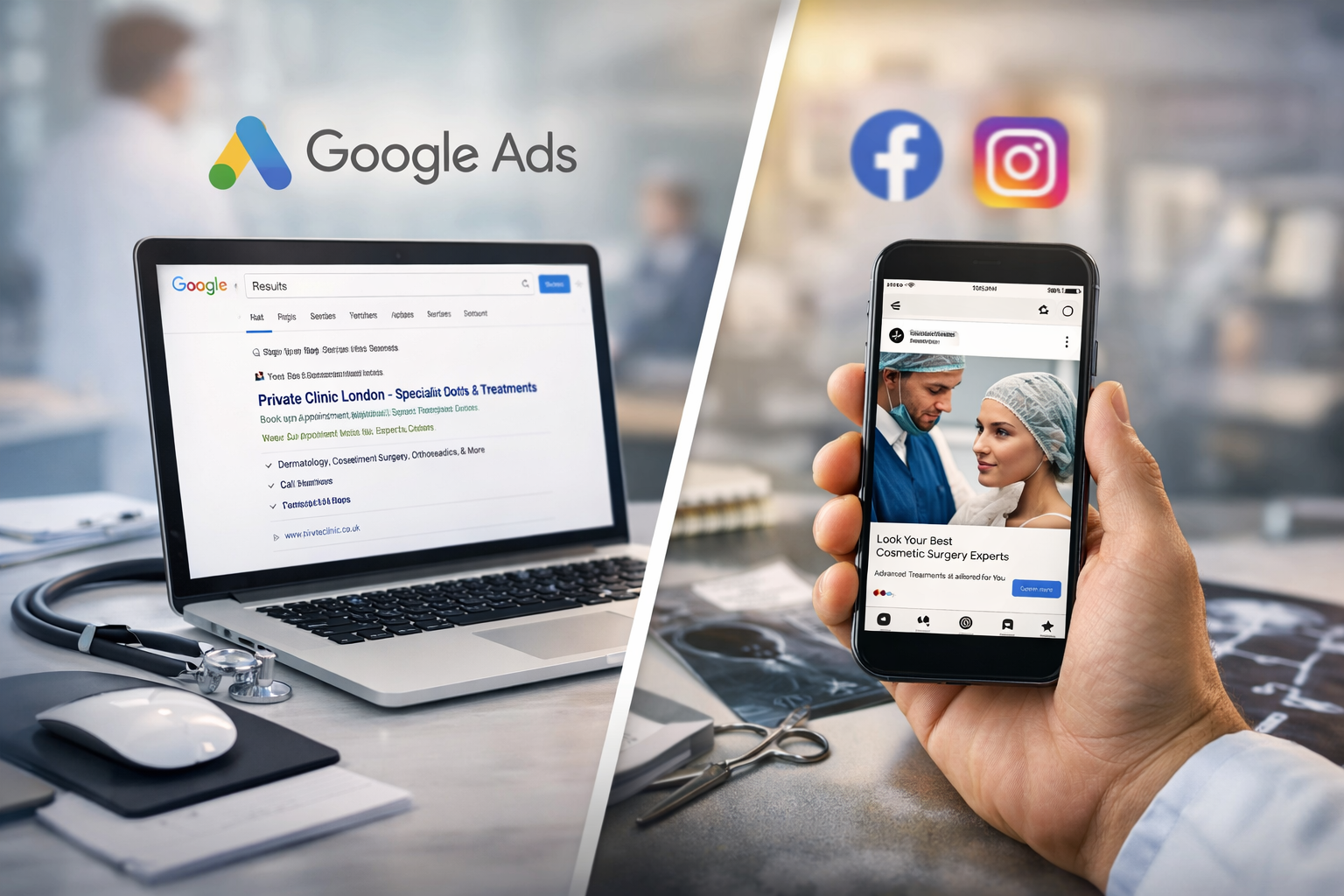
Google Ads captures patients who are actively searching for a specific service. Someone searching “private dermatologist London” is in a decision-making phase. Google puts your clinic in front of them at that exact moment. That is high-intent traffic, and it converts.
Meta Ads (Facebook and Instagram) work differently. You reach people who are not searching for you. Your ads appear in feeds and stories while they are doing something else. The intent is not there yet. The opportunity is to create it.
Neither approach is wrong. But understanding this difference is fundamental to spending wisely.
Google Ads for Private Clinics: Strengths and Limitations
Where Google Ads Excels
Google Ads is the dominant paid channel for most private healthcare providers. When a patient searches for a specific procedure or specialist, search ads place your clinic at the top of the results.
The key advantages for private clinics include:
- High-intent traffic. Patients searching for a treatment are far more likely to enquire than passive scrollers.
- Precise keyword targeting. You target specific procedures, locations, and search phrases.
- Measurable cost per enquiry. Every click, call, and form submission links directly to the campaign.
- Fast results. A well-structured campaign can generate enquiries within days of going live.
- Compatibility with SEO. Paid search and organic SEO reinforce each other, boosting total visibility.
Where Google Ads Has Limitations
Google Ads is not without challenges in the healthcare sector. Costs per click for medical keywords in competitive UK cities can be significant.
Without a specialist healthcare PPC strategy, budget disappears quickly on poorly targeted keywords.
Google also enforces strict healthcare advertising policies. These restrict certain claims, require compliant landing pages, and limit remarketing for sensitive health conditions. Managing these rules requires expertise.
For a full breakdown of our approach, see our Healthcare PPC Advertising page.
Meta Ads for Private Clinics: Strengths and Limitations
Where Meta Ads Excels
Meta Ads offer capabilities that Google cannot replicate. Visual storytelling, audience building, and brand awareness are all strong suits.
For private clinics, the strongest use cases include:
- Before and after content. Visual results for aesthetic and cosmetic procedures perform well on Instagram and Facebook, building trust with prospective patients.
- Lookalike audience targeting. Meta identifies people who share traits with your existing patients. This helps you reach new audiences more likely to convert.
- Retargeting warm audiences. If someone visited your website or watched a video, Meta Ads can re-engage them with a relevant follow-up message.
- Brand awareness at scale. For newly opened clinics or expanding practices, Meta offers cost-effective exposure to large local audiences.
- Social proof amplification. Testimonials and patient stories perform well in social formats and build the credibility patients look for.
Where Meta Ads Has Limitations
Meta’s advertising policies for healthcare have become increasingly restrictive. Targeting based on health conditions or sensitive personal data is significantly limited.
This makes it harder to reach the precise audiences that Google’s keyword intent allows.
Conversion rates from Meta traffic are also typically lower for direct enquiry campaigns. A patient who clicks a Google ad for “private cataract surgery” is far closer to booking than someone pausing on an Instagram post.
Compliance is a genuine concern too. Meta’s automated review system can flag legitimate healthcare ads. Account restrictions can follow. Working with an agency that understands healthcare compliance is essential on this platform.
Comparing ROI: What the Data Tells Us for Healthcare
ROI comparisons are difficult to generalise. They depend heavily on your service type, geography, and conversion infrastructure. However, some consistent patterns emerge:
| Factor | Google Ads | Meta Ads |
| Search Intent | High. Patients actively search for a procedure or clinic. | Low to medium. Patients browse rather than search. |
| Speed to Results | Fast. Enquiries can arrive within days of launch. | Variable. Depends on creative quality and audience warm-up. |
| Cost Per Enquiry | Higher CPC but stronger intent signals. | Lower CPC but lower conversion rates in most healthcare niches. |
| Best For | Surgical procedures, consultations, urgent care. | Brand awareness, before and after content, social proof. |
| Compliance Risk | Moderate. Google healthcare ad policies apply. | Higher. Meta restricts healthcare targeting more strictly. |
| Retargeting | Available via Google Display Network. | Strong. Meta leads on visual retargeting. |
| Long-Term Value | Strong when paired with an SEO strategy. | Strong for brand recall and nurturing warm audiences. |
For most private clinics, Google Ads delivers a stronger immediate return on enquiry-generation campaigns. Meta Ads delivers stronger returns over a longer window when used for awareness, nurturing, and retargeting.
The Healthcare Compliance Dimension
Both platforms restrict healthcare advertising. But they operate differently and carry different risk profiles.
Google’s policies focus on landing page quality, accurate claims, and appropriate targeting. Ads for prescription medications and certain surgical procedures may require pre-certification. These restrictions are manageable with the right setup.
Meta’s policies are evolving and, in some areas, more ambiguous. The platform has restricted detailed health-based targeting options. Content referencing health conditions or medical procedures can be flagged even when fully compliant.
Healthcare advertisers need a clear compliance framework before running campaigns on either platform.
This is especially important given that private healthcare sits within Google’s YMYL content category.
Should Private Clinics Use Both Platforms?
In most cases, yes. But the allocation should reflect the role each platform plays, not a simple budget split.
A practical framework for most private clinics looks like this:
- Google Ads handles active demand. It captures patients already in the decision-making process for specific treatments.
- Meta Ads builds the pipeline. It creates awareness, nurtures interest, and re-engages people who have already interacted with your brand.
- Retargeting bridges the two. Patients who click a Google ad but do not enquire can be retargeted through Meta with supporting content or testimonials.
This is not a one-size-fits-all formula. A newly opened clinic may start with heavy Meta investment to build local awareness. It can then shift budget toward Google as the patient pipeline develops.
An established surgical practice may find Google Ads alone drives sufficient enquiry volume.
Integrating Paid Ads with Your Wider Healthcare Marketing Strategy
The clinics achieving the strongest paid advertising ROI are rarely those spending the most. They are the ones with a coherent strategy.
That strategy connects paid ads to a well-structured website, quality landing pages, and a growing organic presence.
Our Healthcare SEO services are designed to work alongside paid media. They build organic demand that complements your ad spend and reduces long-term cost per acquisition.
Paid ads without a strong landing page waste budget. Paid ads without SEO leave long-term value untouched. SEO without paid media means slower traction in competitive markets.
The most effective healthcare marketing strategies coordinate all three channels around patient intent.
For an overview of our integrated approach, visit our Healthcare Digital Marketing page.
Key Questions to Ask Before Allocating Your Budget
Before splitting your paid media budget, work through these questions:
- What is the primary goal of this campaign? Immediate enquiry generation or longer-term brand building?
- What is the patient journey for this service? Are patients searching actively or discovering passively?
- What does your current website conversion rate look like? A low rate means more spend is wasted on any platform.
- Do you have compliant landing pages for each service? Generic homepages rarely convert paid traffic efficiently.
- Is there an existing audience to retarget? If your website already gets traffic, Meta retargeting can activate quickly.
- What does your SEO visibility look like? Strong organic rankings for a keyword mean paid spend there may duplicate results.
Summary: Google Ads vs Meta Ads for Private Clinics
Both platforms have a legitimate role in private healthcare marketing.
Google Ads delivers stronger immediate ROI for enquiry-generation campaigns. It captures high-intent patients at the point of search.
Meta Ads delivers longer-term value through brand awareness, audience building, and retargeting.
The question is not which platform wins. It is how to deploy each one effectively within a strategy built around your services, patient journey, and growth objectives.
Proper compliance oversight, conversion-focused landing pages, and integration with your SEO strategy are where the real ROI is found.
