

The Visibility Problem Most Surgeons Face
You are an excellent surgeon. Your outcomes are strong. Your patients refer others.
But when a prospective patient searches for your specialty online, your name does not appear.
Someone else does.
This is not a reflection of your clinical ability. It is a reflection of your digital presence. And in private practice, your digital presence is increasingly the first thing a patient encounters before they ever consider picking up the phone.
SEO for surgeons is not about gaming Google. It is about making sure the patients who need your expertise can actually find you.
This guide explains how surgeon SEO works, why it differs from clinic SEO, and what you need to do to build the kind of online authority that consistently attracts private patients.
Why Surgeon SEO Is Different From Clinic SEO
Most healthcare SEO content focuses on clinics, practices, and hospitals. Surgeon SEO operates differently because the audience is searching for a person, not just a service.
When a patient decides to seek private surgical care, they typically go through two stages. First, they search for the procedure or condition. Then, once they understand what they need, they search for the best surgeon to treat them.
That second search is where your personal authority matters most.
Searches like “best knee surgeon London”, “private orthopaedic surgeon Manchester”, or “rhinoplasty surgeon UK” are high intent. The person typing those terms is not researching. They are close to making a decision.
If your name and profile do not appear at that moment, you are invisible to patients who are ready to book.
What Google Looks for When Ranking Surgeons
Google applies particularly rigorous standards to healthcare content. It falls under what Google calls YMYL, which stands for Your Money or Your Life. This means content that could directly affect someone’s health, safety, or finances is held to a higher standard of trust and accuracy.
For surgeons specifically, Google is looking for clear evidence of expertise, authority, and trustworthiness. These are the three pillars of what Google refers to as E-E-A-T.
In practice, this means Google is assessing signals like:
- Whether your name appears on credible medical websites and professional directories
- Whether your website clearly states your qualifications, training, and surgical experience
- Whether other reputable sources link to or mention your work
- Whether patients have reviewed you on trusted platforms
- Whether your content demonstrates genuine clinical expertise
A surgeon with a strong E-E-A-T profile will consistently outrank a generic clinic page targeting the same keywords, even if that clinic has a larger website.
Understanding and building these signals is the foundation of effective healthcare SEO for surgeons.
The Core Elements of Surgeon SEO
1. Your Personal Profile Page
The most important page on any surgeon’s website is their personal profile. This is the page Google uses to assess your authority, and it is the page prospective patients use to decide whether they trust you.
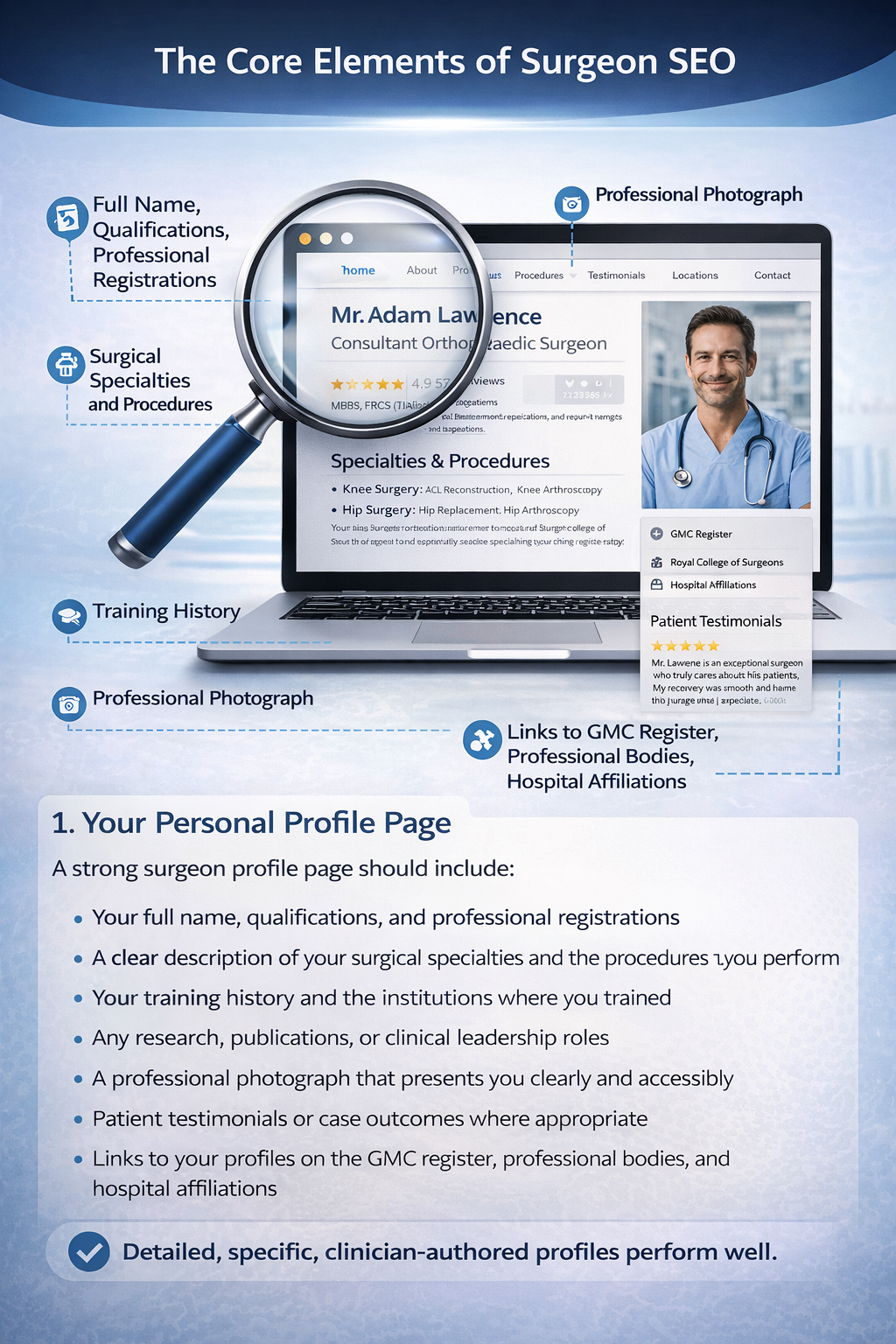
A strong surgeon profile page should include:
- Your full name, qualifications, and professional registrations
- A clear description of your surgical specialties and the procedures you perform
- Your training history and the institutions where you trained
- Any research, publications, or clinical leadership roles
- A professional photograph that presents you clearly and accessibly
- Patient testimonials or case outcomes where appropriate
- Links to your profiles on the GMC register, professional bodies, and hospital affiliations
Generic profiles that simply list a surgeon’s name and specialty perform poorly. Detailed, specific, clinician-authored profiles perform well.
2. Procedure-Level Content
Patients searching for surgical care are often searching for specific procedures. “Private ACL reconstruction UK”, “septoplasty surgeon Glasgow”, “laparoscopic cholecystectomy private” are all examples of procedure-level searches with strong patient intent.
Creating dedicated, well-written pages for each of your core procedures gives Google a clear signal that you are an authority in that specific area. It also gives patients the information they need to feel confident before making contact.
Each procedure page should explain what the procedure involves, who is a suitable candidate, what the recovery process looks like, and what a patient can expect from a consultation with you. Content written with genuine clinical knowledge, in clear and accessible language, consistently outperforms generic descriptions.
3. Local SEO for Surgeons
Most private surgical patients search with location intent. They want someone within a reasonable distance who they can see for a consultation without significant travel.
Local SEO for surgeons means making sure your name appears when patients search for your specialty in your area. This involves:
- Claiming and optimising your Google Business Profile with your correct specialty, location, and contact details
- Ensuring your name, address, and phone number are consistent across all directories
- Generating genuine patient reviews on Google and other trusted platforms
- Creating location-specific content that references where you practice
If you work across multiple hospitals or consulting rooms, each location should be optimised individually. A surgeon who operates in both London and Birmingham, for example, should have content and directory listings that reflect both locations clearly.
4. Professional Directory Listings
Google cross-references surgeon profiles across multiple authoritative sources. Being listed consistently and accurately on the right directories significantly strengthens your authority signals.
Key directories for UK surgeons include the GMC register, the Royal College of Surgeons fellowship directory, Hospital websites where you hold practicing privileges, Doctify, Top Doctors, and Trustpilot for healthcare professionals.
These listings do more than build SEO authority. They are also part of the patient’s research journey. Patients regularly check these platforms before making an enquiry, and a strong, complete profile on each one reinforces your credibility at a critical moment.
5. Patient Reviews and Reputation
Reviews are both an SEO signal and a conversion signal. Google factors review volume and quality into local search rankings. Patients factor them into their decision making.
A surgeon with 40 detailed, positive reviews on Google and Doctify will almost always outrank and outconvert a surgeon with five reviews, regardless of clinical excellence.
Building a consistent review generation process is one of the highest-return activities a surgeon in private practice can invest in. That means making it easy for satisfied patients to leave a review, following up at the right point in the patient journey, and responding professionally to all feedback received.
Reputation management is something we integrate into our work with surgeons specifically because of how directly it affects both rankings and patient acquisition.
6. A Website That Reflects Your Authority
Many surgeons either have no personal website, rely entirely on their hospital or clinic’s website, or have an outdated site that does not reflect their current practice.
A personal surgeon website, properly built and maintained, is one of the most powerful tools available for private patient acquisition. It gives you full control over how you present yourself, what procedures you highlight, and how patients find and contact you.
At minimum, a surgeon’s website should include a strong personal profile page, individual procedure pages, a patient testimonials section, clear contact details and a simple enquiry process, and links to your professional registrations.
The design and structure of that website matters as much as the content. A slow, poorly structured, or visually outdated site will undermine the trust signals you are trying to build. Healthcare website creation and management done properly should position your site as a reflection of the quality of care you provide.
Common Surgeon SEO Mistakes
Relying Entirely on Your Hospital or Clinic’s Online Presence
When you are listed on a hospital website, you are one name among many. The hospital’s SEO benefits from your association, but your personal brand does not develop. If you move hospitals or expand your private practice, that visibility does not follow you.
Building your own digital presence runs alongside your hospital profile. It does not replace it.
Ignoring Google Business Profile
Many surgeons overlook Google Business Profile entirely, assuming it is only relevant for physical retail businesses. In fact, a well-optimised surgeon profile on Google Business is one of the fastest ways to appear in local search results for your specialty.
Publishing Thin or Generic Content
Content that simply lists a procedure name and a brief description does not rank well and does not convert visitors into patients. Google rewards depth, clinical specificity, and evidence of genuine expertise.
Not Asking for Reviews
Patient reviews rarely happen without prompting. Most satisfied patients will not think to leave a review unless they are asked at the right moment, with a simple and direct way to do so.
How Long Does Surgeon SEO Take?
Surgeon SEO is not an overnight solution. Building genuine authority in Google’s eyes takes time, consistency, and a structured approach.
Most surgeons working with a specialist healthcare SEO partner begin to see meaningful movement in their rankings within three to four months. Consistent enquiry generation from organic search typically follows within six months.
The return on that investment, once established, is significant. Unlike paid advertising, which stops the moment you stop spending, organic search visibility continues to deliver patient enquiries month after month.
Many Surgeons Also Carry Out Medico-Legal Work
If you provide expert witness reports, independent medical examinations, or medico-legal opinions alongside your clinical practice, your online presence needs to reflect that separately. Solicitors and instructing parties searching for medico-legal experts use different search terms and evaluate experts differently from patients searching for surgical care.
Building a dedicated medico-legal profile that sits alongside your clinical SEO ensures you are visible to both audiences. Our guide to medical legal SEO covers exactly how to approach this.
How Nexus Healthcare Supports Surgeons
At Nexus Healthcare, we work with surgeons across the UK to build the kind of digital authority that translates into consistent private patient enquiries.
Our work covers the full picture, including healthcare SEO strategy built around your specific specialties and locations, personal surgeon websites that reflect your clinical authority, procedure-level content written to rank and convert, directory and reputation management to strengthen your trust signals, and digital creative solutions including professional photography and video that make your profile stand out.
If you are a surgeon looking to grow your private practice through search, we would be glad to talk through what is possible.
