

The Medico-Legal Market Has a Visibility Problem
Medico-legal work is a specialist field. The pool of qualified experts is relatively small. The instructions available are significant.
Yet many highly qualified medico-legal experts, whether consultant surgeons, psychiatrists, GPs, or allied health professionals, are almost entirely invisible online.
They rely on word of mouth, agency relationships, and existing solicitor contacts to generate instructions. Those channels work, up to a point. But they have a ceiling.
The solicitors, insurers, and case managers actively searching online for medico-legal experts right now will instruct the experts they find. If you are not findable, those instructions go elsewhere.
This guide explains how SEO works for medico-legal professionals, what those searching for experts are actually looking for, and how to build the kind of online presence that generates consistent new instructions.
Who Is Searching for Medico-Legal Experts Online?
Before building an SEO strategy, it helps to understand exactly who you are trying to reach and what they are searching for.
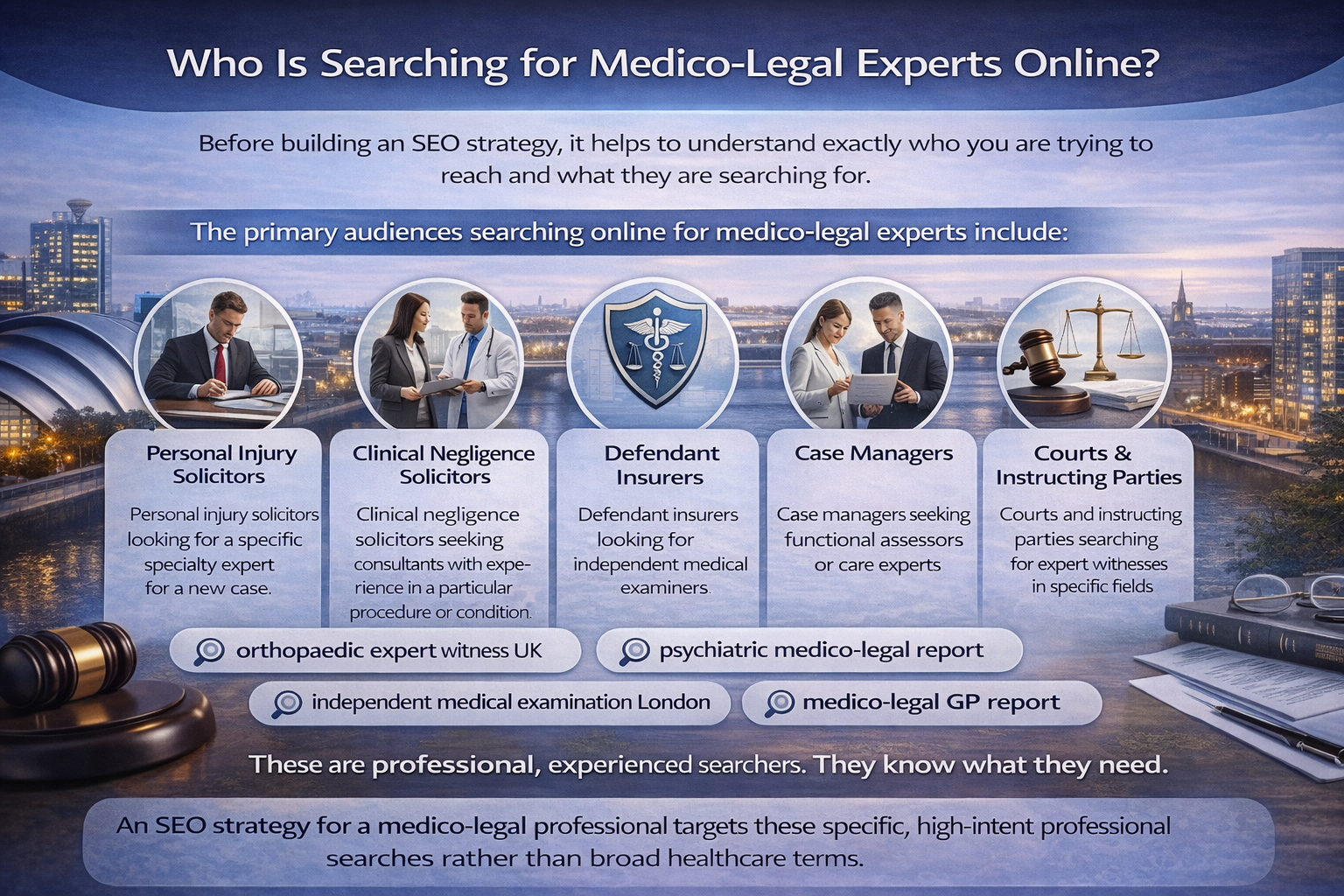 The primary audiences searching online for medico-legal experts include:
- Personal injury solicitors looking for a specific specialty expert for a new case
- Clinical negligence solicitors seeking consultants with experience in a particular procedure or condition
- Defendant insurers looking for independent medical examiners
- Case managers seeking functional assessors or care experts
- Courts and instructing parties searching for expert witnesses in specific fields
These are professional, experienced searchers. They know what they need. They are searching with precision.
Searches in this space look like “orthopaedic expert witness UK”, “psychiatric medico-legal report”, “independent medical examination London”, “consultant cardiologist expert witness”, or “medico-legal GP report”.
An SEO strategy for a medico-legal professional targets these specific, high-intent professional searches rather than broad healthcare terms.
Why Most Medico-Legal Professionals Are Invisible in Search
The medico-legal sector is notably underserved in terms of digital presence. Most experts have either no online presence beyond a basic NHS or hospital profile, or a personal website that has not been updated in years.
This is actually an opportunity. Because the competition for medico-legal search terms is relatively low compared to clinical healthcare searches, a well-executed SEO strategy can achieve meaningful visibility considerably faster than in more competitive healthcare markets.
The reasons most medico-legal professionals remain invisible online come down to a few consistent patterns.
No Dedicated Medico-Legal Web Presence
Many medico-legal experts rely entirely on their clinical employer’s website or a basic listing on a medico-legal agency directory. Neither of these builds your personal authority or gives you any control over how you appear to those searching for you.
A dedicated medico-legal website, even a focused and well-structured one, gives Google a clear and specific resource to index and rank for the searches that matter to your practice.
Specialty and Experience Not Clearly Communicated
Solicitors instructing a medico-legal expert need to quickly establish whether that expert has the precise specialty, clinical experience, and report-writing credentials relevant to their case. A vague or generic online profile fails at the first hurdle.
Your online presence needs to communicate your specific subspecialties, the types of cases you have experience in, your clinical background, your court experience if applicable, and the geographic areas you cover.
No Content Demonstrating Expertise
Google rewards content that demonstrates genuine expertise in a specific area. A medico-legal expert who publishes articles or guides covering topics relevant to their field, such as how causation is assessed in orthopaedic injury claims, or what a psychiatric medico-legal report covers, builds authority signals that improve search rankings over time.
This kind of content also serves a practical purpose. It gives instructing solicitors evidence of your thinking and your communication style before they ever make contact.
The Core Elements of Medico-Legal SEO
1. A Dedicated Medico-Legal Website
Your medico-legal practice deserves its own online home, separate from your clinical employer’s website and independent of any agency directory listing.
A well-structured medico-legal website should include:
- A clear and detailed profile covering your specialty, subspecialties, and clinical background
- A specific page covering your medico-legal services and the types of reports you provide
- Your geographic coverage and whether you conduct remote or in-person examinations
- Court experience and any relevant training such as Bond Solon or equivalent
- Professional memberships and registrations
- A straightforward enquiry process with fast response expectations
- Case types or conditions you have particular experience in
The structure and quality of that website matters as much as its existence. A slow, poorly organised, or visually unprofessional site undermines the credibility you are trying to establish. Healthcare website creation and management built for professional audiences prioritises clarity, credibility, and a clean user experience.
2. Keyword Targeting for Medico-Legal Search Terms
Effective medico-legal SEO starts with understanding the precise language solicitors use when searching for experts.
This differs from clinical patient language. Solicitors search using specific professional terminology. They search for “independent medical examiner”, “expert witness report”, “causation opinion”, and “medico-legal consultant” rather than the patient-facing terms your clinical website might target.
Your website content, page titles, and metadata need to reflect this professional search language clearly and consistently.
Specialty-specific terms matter too. An orthopaedic surgeon offering medico-legal services should be visible for searches like “orthopaedic expert witness spinal injury” or “independent orthopaedic report UK” rather than simply “orthopaedic surgeon”.
3. Positioning Your Expertise Clearly
In medico-legal work, specificity builds trust. A solicitor handling a complex spinal injury claim does not want a general surgeon. They want someone with demonstrable experience in spinal cases specifically.
Your online presence should make it immediately clear what types of cases you are most experienced in, what conditions or injuries you regularly report on, and what makes your reports and opinions particularly valuable to instructing parties.
This level of specificity also helps with SEO. Specific, detailed content about precise subspecialties and case types ranks better for the precise searches solicitors are making than generic descriptions of your broader clinical career.
4. Directory Listings and Professional Profiles
Medico-legal experts are listed across a range of professional directories that solicitors actively use when searching for experts. Being present, complete, and consistent across these directories builds both your credibility with instructing parties and your authority signals with Google.
Key directories for UK medico-legal professionals include the Expert Witness Institute, the Academy of Experts, APIL’s expert witness directory, medico-legal agency directories where you are registered, and your Royal College or professional body’s directory.
Consistency matters. Your name, specialty, and contact details should appear identically across every platform where you are listed.
5. Content That Demonstrates Your Expertise
Publishing regular, professionally written content on your medico-legal website builds authority in Google’s eyes and gives instructing solicitors evidence of your knowledge and communication style.
Well-performing content topics for medico-legal professionals include:
- How causation is assessed in personal injury claims in your specialty
- What a high-quality medico-legal report should include
- Common issues in clinical negligence cases within your area of expertise
- How to instruct an independent medical examiner
- The difference between prognosis and causation opinions
This content does not need to be lengthy or complex. It needs to be genuinely expert, clearly written, and directly relevant to the questions instructing solicitors are asking. This is the kind of content that healthcare SEO strategy built around E-E-A-T principles prioritises.
6. Local and Regional Visibility
While medico-legal work is often conducted remotely or at examination centres, many solicitors prefer experts within a reasonable geographic range for court attendance and in-person examinations.
Location-specific optimisation helps you appear for searches that include geographic terms. “Expert witness Manchester”, “independent medical examiner Scotland”, or “medico-legal consultant Birmingham” are all searches made by solicitors with a geographic preference.
Ensuring your location and geographic coverage are clearly stated across your website and directory listings captures this segment of search traffic effectively.
Building Your Personal Brand as a Medico-Legal Expert
SEO for medico-legal professionals overlaps significantly with personal branding. In a field where instructing solicitors are choosing between individual experts rather than between organisations, your personal reputation and visibility are the same thing.
Elements that strengthen both your personal brand and your SEO authority include:
- Publishing articles or commentary in legal publications or medico-legal journals
- Speaking at conferences or training events for solicitors or legal professionals
- Being quoted as an expert in relevant press coverage
- Maintaining an active and professional LinkedIn presence that links to your website
- Receiving and responding to reviews or testimonials from instructing solicitors where appropriate
Each of these activities generates online mentions and links that reinforce your authority in Google’s assessment of your expertise. They also make you more visible to the solicitors who attend those events, read those publications, and search for the experts they have encountered elsewhere.
Digital creative solutions including professional photography and well-produced profile content make a significant difference to how credible and authoritative a medico-legal expert appears online. First impressions in a professional context carry considerable weight.
Are You a Surgeon Offering Medico-Legal Services?
Many of the medico-legal experts most in demand are surgeons. Orthopaedic, spinal, plastic, and general surgeons regularly provide expert witness reports and independent medical examinations alongside their clinical practice.
If that applies to you, your clinical SEO and your medico-legal SEO need to work together but operate separately. Our guide to SEO for surgeons UK covers how to build your personal clinical authority online, which complements and reinforces your medico-legal profile.
How Nexus Healthcare Supports Medico-Legal Professionals
Nexus Healthcare brings specialist healthcare marketing expertise to the medico-legal sector. We understand both the clinical context and the professional audience you are trying to reach.
Our work with medico-legal professionals covers healthcare SEO strategy tailored to professional search behaviour, dedicated medico-legal website design and development, specialty and case-type content that demonstrates expertise, directory and profile management across relevant platforms, and digital creative solutions that present your credentials and experience with the professionalism your audience expects.
We also offer medical legal advisory services for healthcare providers navigating the intersection of clinical practice and legal process.
If you are a medico-legal professional looking to grow your instruction volume through better online visibility, we would be glad to talk through what is possible.
