Cosmetic surgery is one of the most competitive sectors in UK private healthcare. Patients research procedures carefully, compare multiple clinics, and often take weeks or months before they enquire. When they are ready to act, they go directly to Google. If your clinic is not appearing at the top of those results, a competitor is taking that patient.
Pay Per Click advertising gives cosmetic surgery clinics immediate visibility at the exact moment a patient is searching for a procedure. However, running PPC in healthcare is not the same as running PPC in other industries. The regulations are stricter, the search intent is more complex, and the cost of getting it wrong is higher. This guide covers what cosmetic surgery clinics need to know to run Google Ads campaigns that actually generate enquiries.
Why Cosmetic Surgery Clinics Need a Different PPC Approach
Generic PPC agencies treat healthcare like any other industry. They focus on click volume, broad keywords, and low cost-per-click. For cosmetic surgery, that approach wastes budget and attracts the wrong traffic.
Cosmetic surgery patients are high-intent but slow to convert. They are not making an impulse purchase. They are researching surgeons, comparing before-and-after results, reading reviews, and assessing trust. Your Google Ads campaign needs to reflect that journey. Every element, from keyword selection to ad copy to landing page, must be built around how cosmetic surgery patients actually search and decide.
Furthermore, cosmetic surgery advertising is subject to strict ASA and CAP guidelines. Ads cannot make misleading claims, use before-and-after imagery inappropriately, or target under-18s. Google also applies additional restrictions to healthcare advertisers. Specialist management is therefore essential, not optional.
What Google Ads Can Do for a Cosmetic Surgery Clinic
When managed correctly, PPC advertising for healthcare providers delivers several advantages that organic search alone cannot match.
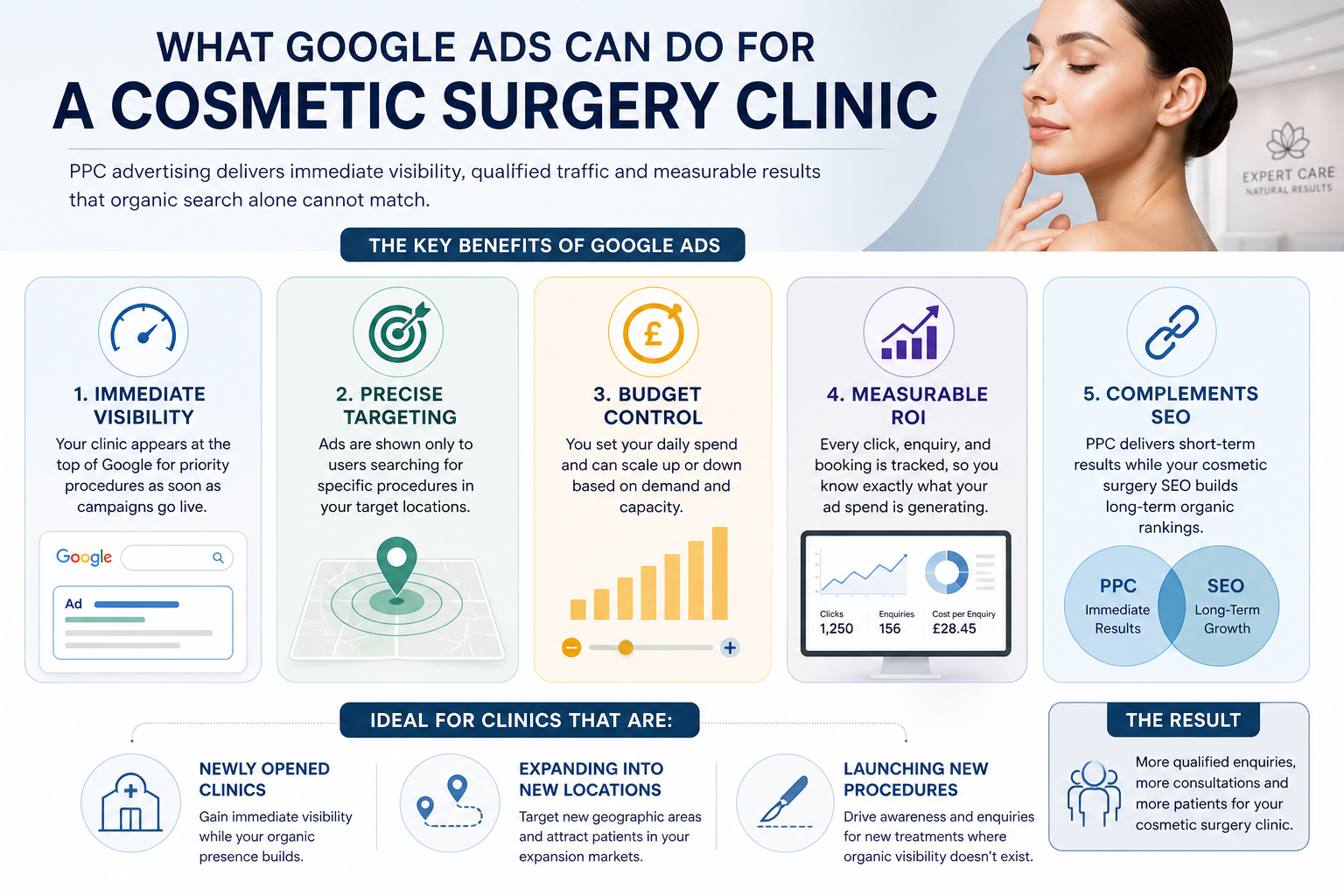 Immediate visibility: Your clinic appears at the top of Google for priority procedures as soon as campaigns go live.
- Precise targeting: Ads are shown only to users searching for specific procedures in your target locations.
- Budget control: You set your daily spend and can scale up or down based on demand and capacity.
- Measurable ROI: Every click, enquiry, and booking is tracked, so you know exactly what your ad spend is generating.
- Complements SEO: PPC delivers short-term results while your cosmetic surgery SEO builds long-term organic rankings.
As a result, PPC is particularly valuable for newly opened clinics, clinics expanding into new locations, and clinics launching new procedures where organic visibility does not yet exist.
The Right Keywords for Cosmetic Surgery Google Ads
Keyword strategy is where most cosmetic surgery PPC campaigns fail. Broad, generic terms like “cosmetic surgery” attract high search volumes but low conversion rates. The patients clicking those terms are often at the very start of their research journey and are not ready to enquire.
Instead, effective campaigns prioritise three types of search intent:
Procedure-specific keywords
Terms like “rhinoplasty surgeon UK”, “breast augmentation clinic London”, or “tummy tuck cost UK” indicate a patient who knows what they want. These searches convert at a significantly higher rate than general terms.
Location-based keywords
Adding geographic qualifiers such as “clinic near me”, “Manchester”, or “North West” targets patients within a realistic travel distance. This is especially important for clinics outside London competing against central city providers.
Comparison and cost keywords
Searches like “blepharoplasty cost UK” or “best rhinoplasty surgeon” show a patient who is actively comparing options. These are high-value clicks. Your ads and landing pages must answer these questions directly to capture the enquiry.
Negative keywords are equally important. Adding terms like “NHS”, “cheap”, and “DIY” filters out low-quality traffic that would otherwise consume budget without converting.
Ad Copy That Complies and Converts
Writing Google Ads copy for cosmetic surgery requires balancing compliance with persuasion. ASA guidelines prohibit misleading claims, and Google’s healthcare advertising policies restrict certain types of language and imagery. However, within those constraints, there is significant room to write ads that stand out and drive qualified clicks.
Effective cosmetic surgery ad copy typically includes:
- The specific procedure in the headline, matching the patient’s search term exactly
- A clear value proposition, such as surgeon credentials, clinic accreditation, or years of experience
- A direct call to action, such as “Book a Free Consultation” or “Request a Callback Today”
- Location references where relevant, to reinforce geographic relevance
- Ad extensions including sitelinks, callouts, and structured snippets to increase ad size and visibility
Importantly, ad copy must avoid unsubstantiated superlatives, before-and-after claims, and anything that could be interpreted as targeting vulnerable patients. Compliance is not just an ethical requirement. It protects your Google Ads account from suspension.
Landing Pages: Where Cosmetic Surgery Enquiries Are Won or Lost
Even the best Google Ads campaign fails if the landing page does not convert. For cosmetic surgery, the landing page is often the first impression a prospective patient has of your clinic. It must build trust, answer key questions, and make it easy to enquire.
A high-converting healthcare landing page for a cosmetic surgery procedure typically includes:
- A clear headline matching the ad and the search term
- Surgeon credentials, GMC registration, and relevant professional memberships
- Patient testimonials and verified reviews
- Transparent information about the procedure, recovery, and realistic outcomes
- A prominent and simple enquiry form or click-to-call button
- Mobile optimisation, as a significant proportion of cosmetic surgery searches happen on mobile devices
Page speed also has a direct impact on conversion rates. A landing page that takes more than three seconds to load will lose a substantial proportion of visitors before they even read your content. If you want to understand how this affects enquiry volume, our guide on how page speed affects patient enquiries covers this in detail.
Furthermore, each procedure should ideally have its own dedicated landing page. Sending all PPC traffic to a generic homepage or a general treatments page significantly reduces conversion rates because the page does not match the specific intent of the search.
Geographic Targeting for Cosmetic Surgery PPC
Most cosmetic surgery clinics serve patients within a defined catchment area, though some attract patients from across the UK for specialist procedures. Geographic targeting in Google Ads allows you to show ads only to users in relevant locations, so budget is not wasted on searches from areas you do not serve.
For clinics in competitive city markets, radius targeting can focus spend on the immediate area. For clinics offering specialist procedures, broader regional or national targeting may be appropriate. In either case, location bid adjustments allow you to increase spend in higher-value areas while maintaining coverage across a wider region.
Local visibility is also closely connected to your broader local SEO strategy for private clinics. PPC and local SEO working together creates a stronger overall presence in location-based searches.
Tracking, Measurement and ROI
One of the key advantages of Google Ads vs other advertising channels is the level of measurability available. Every aspect of campaign performance can be tracked, from initial click through to form submission and phone call.
For cosmetic surgery clinics, the most important metrics to track are:
- Cost per enquiry: How much does it cost to generate one qualified consultation request?
- Conversion rate: What percentage of landing page visitors submit an enquiry?
- Quality Score: Google’s measure of ad relevance, which directly affects cost-per-click
- Impression share: What proportion of relevant searches your ads are appearing for
- Return on ad spend (ROAS): Revenue generated relative to ad spend, calculated using average procedure values
Regular reporting and ongoing optimisation are what separate effective PPC management from set-and-forget campaigns. Bids, keywords, ad copy, and landing pages should all be reviewed and refined continuously based on performance data.
PPC Compliance for Cosmetic Surgery Advertising
Cosmetic surgery is one of the most heavily regulated areas of healthcare advertising in the UK. Before running any Google Ads campaign, clinics must understand the relevant compliance requirements.
Key compliance considerations include:
- ASA and CAP guidelines prohibit misleading claims about results, recovery times, or risks
- Before-and-after imagery is restricted in most advertising contexts for cosmetic procedures
- Ads must not be targeted at under-18s or use content likely to appeal to minors
- Google requires healthcare advertisers in certain categories to complete a certification process
- Landing pages must include appropriate disclaimers and present balanced information about risks
Working with an agency that understands healthcare advertising compliance is therefore essential. Non-compliant ads can result in account suspension, regulatory investigation, and reputational damage.
How PPC and SEO Work Together for Cosmetic Surgery Clinics
PPC and SEO for cosmetic surgery clinics are most effective when they are part of a coordinated strategy rather than separate activities.
PPC delivers immediate visibility for priority procedures and locations. SEO builds long-term authority, organic rankings, and trust signals over time. Together, they allow a clinic to dominate both the paid and organic sections of search results, increasing overall visibility and reducing dependence on a single channel.
Additionally, PPC data provides valuable insight for SEO. The keywords that convert well in paid search are strong candidates for organic content investment. Conversely, procedures and locations where organic rankings are already strong may require less PPC spend, allowing budget to be redirected to more competitive areas.
For a broader view of how all digital marketing channels work together, our healthcare SEO strategy guide covers the full picture.
Common Mistakes in Cosmetic Surgery PPC Campaigns
Based on our experience managing PPC for healthcare providers across the UK, these are the most common mistakes cosmetic surgery clinics make with Google Ads:
- Sending all traffic to the homepage: Generic landing pages convert poorly. Each procedure needs its own dedicated page.
- Ignoring negative keywords: Without a robust negative keyword list, significant budget is wasted on irrelevant searches.
- Running broad match only: Broad match keywords generate volume but attract low-intent traffic. A balanced match type strategy is essential.
- No conversion tracking: Without tracking form submissions and calls, it is impossible to know which campaigns are generating enquiries.
- Setting and forgetting: PPC campaigns require continuous optimisation. Budgets, bids, and keywords all need regular review.
- Ignoring compliance: Non-compliant ads risk account suspension and can cause significant reputational damage.
What to Look for in a Cosmetic Surgery PPC Agency
Not all PPC agencies have the expertise to manage healthcare advertising effectively. When choosing an agency to run Google Ads for your cosmetic surgery clinic, look for:
- Demonstrable experience with healthcare and cosmetic surgery clients specifically
- A clear understanding of ASA, CAP, and Google healthcare advertising policies
- Transparent reporting with cost-per-enquiry and conversion data
- Integration of PPC with your wider healthcare digital marketing strategy
- A strategy-first approach rather than a focus on click volume alone
At Nexus Healthcare, we specialise exclusively in digital marketing for private healthcare providers. Our PPC campaigns are built around patient intent, clinical compliance, and measurable enquiry generation. We do not run generic campaigns. Every strategy is built around your specific procedures, locations, and growth objectives.
FAQs: Google Ads for Cosmetic Surgery Clinics
How much should a cosmetic surgery clinic spend on Google Ads?
Budget depends on the procedures you are promoting, your target locations, and the level of competition in your area. Generally, cosmetic surgery is a competitive category with higher cost-per-click than many other sectors. A realistic starting budget for a focused campaign targeting one or two procedures in a specific location is typically between £1,500 and £4,000 per month. We align spend with expected enquiry volume and procedure values to ensure a clear return on investment.
How quickly will Google Ads generate enquiries for my clinic?
PPC can start generating enquiries as soon as campaigns go live. In practice, the first two to four weeks are a period of optimisation as data accumulates and campaigns are refined. Most clinics begin seeing consistent enquiry generation within the first month, with performance improving further as campaigns are optimised over time.
Can I run Google Ads for cosmetic surgery procedures?
Yes, but with important caveats. Google applies additional restrictions to healthcare and medical advertising. Some procedure categories require prior certification. Ad copy and landing pages must comply with both Google’s policies and UK ASA and CAP guidelines. Working with a specialist healthcare PPC agency reduces the risk of account suspension and ensures campaigns remain compliant.
Do I need separate landing pages for each procedure?
Yes. Dedicated procedure-specific landing pages significantly outperform generic pages in terms of conversion rate. When a patient searches for “rhinoplasty surgeon Manchester” and clicks your ad, they expect to land on a page specifically about rhinoplasty, not a general cosmetic surgery overview. Each priority procedure should have its own optimised landing page.
Should I run PPC and SEO at the same time?
In most cases, yes. PPC delivers immediate visibility while SEO for cosmetic surgery clinics builds long-term organic rankings. Running both simultaneously gives your clinic the best chance of appearing prominently across the full search results page, increasing overall visibility and reducing reliance on a single channel.
Ready to Attract More Cosmetic Surgery Patients with Google Ads?
Nexus Healthcare is a specialist healthcare digital marketing agency working exclusively with private healthcare providers. We build PPC campaigns around patient intent, clinical compliance, and measurable results.
If you want to generate more qualified enquiries for your cosmetic surgery clinic, get in touch with Nexus Healthcare today to discuss a strategy-led Google Ads campaign built specifically for your clinic and procedures.
