

Before a patient picks up the phone or submits an enquiry form, they almost always do one thing first: they search for reviews. In private healthcare, reputation is not just a marketing asset. It is one of the primary factors that determines whether a prospective patient chooses your clinic or goes elsewhere.
The challenge for most private clinics is that reputation management tends to be reactive. Reviews accumulate passively, complaints are dealt with when they arise, and little thought is given to how the overall picture a patient finds online compares to the standard of care actually being delivered. The result is a reputation that drifts rather than one that is actively built.
This guide covers how online reviews affect patient acquisition for private clinics, what a proactive reputation management strategy looks like, and how to turn patient feedback into a consistent driver of enquiries and trust.
Why Online Reputation Matters More in Private Healthcare Than in Other Industries
In most service industries, a strong online reputation is a competitive advantage. In private healthcare, it is closer to a prerequisite. Several factors make reputation uniquely important in this context.
Patients are making high-stakes decisions
Choosing a clinic for a surgical procedure, a fertility treatment, or a cosmetic intervention is not a low-risk purchase. Patients are entrusting their health and often their appearance or wellbeing to a provider they may never have encountered before. In this context, peer reviews from other patients carry enormous weight. A prospective patient cannot assess clinical quality directly, so they rely on the experiences of others as a proxy.
The research journey is longer and more thorough
Private healthcare patients research extensively before enquiring. They visit multiple websites, read reviews across several platforms, compare practitioners, and often spend days or weeks in the consideration phase. Throughout that process, your online reputation is either reinforcing their interest or creating doubt. A thin or mixed review profile at any stage of that journey can redirect a patient to a competitor.
Google and E-E-A-T reward trustworthy providers
Google’s E-E-A-T framework explicitly includes trustworthiness as a ranking factor for healthcare content. A clinic with a strong, verified review profile on Google and third-party platforms is sending trust signals that support both direct patient acquisition and organic search visibility. Reputation management and healthcare SEO are therefore more closely connected than many clinic owners realise.
Negative reviews are disproportionately visible
A single prominent negative review can have an outsized impact on a clinic’s ability to convert prospective patients, particularly if it appears near the top of a Google search or on a high-traffic review platform. Without a strong base of positive reviews to contextualise it, one critical review can meaningfully reduce enquiry rates from organic and paid search traffic alike.
Where Patients Look for Reviews of Private Clinics
Understanding where patients look for reviews is the starting point for any reputation management strategy. The most important platforms for private healthcare clinics in the UK are:
Google Business Profile
Google reviews are the most visible and most influential for most clinics. They appear directly in search results and on Google Maps, meaning they are encountered by patients even before they visit your website. A strong Google review profile with a high volume of recent, detailed reviews is one of the most valuable reputation assets a clinic can build. This also connects directly to local SEO performance, as Google uses review signals as a ranking factor in local search results.
Trustpilot
Trustpilot is widely recognised and trusted by consumers across the UK. Reviews on Trustpilot are verified and cannot be edited by the business, which gives them additional credibility in the eyes of prospective patients. A strong Trustpilot profile also creates additional search visibility, as Trustpilot pages frequently rank on the first page of Google for clinic name searches.
Doctify and iWantGreatCare
Healthcare-specific review platforms such as Doctify and iWantGreatCare are increasingly influential in private healthcare patient decisions. These platforms verify that reviewers are genuine patients, which gives the reviews additional weight. They also rank well in search results for practitioner and clinic name searches, making them an important part of the overall reputation picture.
Facebook and social media
Facebook reviews and recommendations remain relevant, particularly for clinics with an active social media presence. Patients who find a clinic through social media will often check Facebook reviews before enquiring, making this platform an important part of the overall reputation management picture.
Private Healthcare UK and similar directories
Condition and treatment-specific directories are used by patients in the research phase, particularly for more complex or specialist procedures. A well-maintained profile on relevant directories, with up-to-date information and a link to your main review profiles, supports the overall reputation picture.
How to Build a Strong Review Profile Proactively
A strong review profile does not happen by chance. It requires a consistent and systematic approach to encouraging satisfied patients to share their experiences. The following practices are most effective for private healthcare clinics.
Make requesting reviews part of the patient journey
The most effective way to build review volume is to ask every patient, systematically, at the right moment. The optimal timing is typically shortly after a positive interaction, such as a follow-up appointment at which a good outcome has been confirmed, or a post-treatment check-in call. A personal request from a clinician or patient coordinator is more effective than an automated email alone, though both have a role.
Make it easy for patients to leave a review
The fewer steps between the request and the completed review, the higher the completion rate. A direct link to your Google review page, sent by text or email immediately after the request, removes friction. QR codes displayed in clinic waiting areas and treatment rooms can also drive review volume from patients who are still on-site.
Respond to every review, positive and negative
Responding to reviews demonstrates that your clinic is engaged and values patient feedback. For positive reviews, a brief, personal response reinforces the relationship and encourages future patients to leave their own feedback. For negative reviews, a professional and empathetic response can limit reputational damage and, in some cases, turn a dissatisfied patient into one who updates their review following resolution.
Distribute review requests across platforms
Concentrating all reviews on one platform creates vulnerability. If a platform changes its policies, removes reviews, or if a competitor reports your profile, a single-platform strategy can be undone quickly. Spreading review activity across Google, Trustpilot, and a healthcare-specific platform creates a more resilient and comprehensive reputation profile.
Handling Negative Reviews Professionally
Negative reviews are inevitable for any private healthcare clinic. How they are handled has at least as much impact on prospective patients as the review itself. A poorly managed negative review can cause significantly more reputational damage than the original complaint.
Respond promptly and professionally
A response should be posted within 24 to 48 hours of a negative review appearing. The response must be professional, empathetic, and free of defensiveness. Even if the review contains inaccuracies, a public response is not the place to dispute the patient’s account in detail. Instead, acknowledge their experience, express that their feedback is taken seriously, and invite them to contact the clinic directly to resolve the matter.
Never include clinical or personal details in a public response
Confidentiality obligations apply to public review responses. Never include details that could identify a patient, reference their treatment, or disclose any information about their care in a public forum. If a patient has included clinical details in their own review, the response should still avoid confirming or adding to them. This is both a legal requirement and a matter of professional conduct.
Take the conversation offline
The goal of a public response to a negative review is to demonstrate professionalism and invite resolution, not to resolve the complaint publicly. Every response should include a direct invitation to contact the clinic by phone or email, with a named point of contact where possible. Resolving the underlying complaint privately often leads to the patient updating or removing the negative review.
Know when to escalate
Some reviews contain content that may be eligible for removal under platform policies, such as reviews that are demonstrably false, relate to a different business, or contain inappropriate language. Understanding the removal request process for each platform and when to use it is part of a comprehensive complaint and reputation management approach.
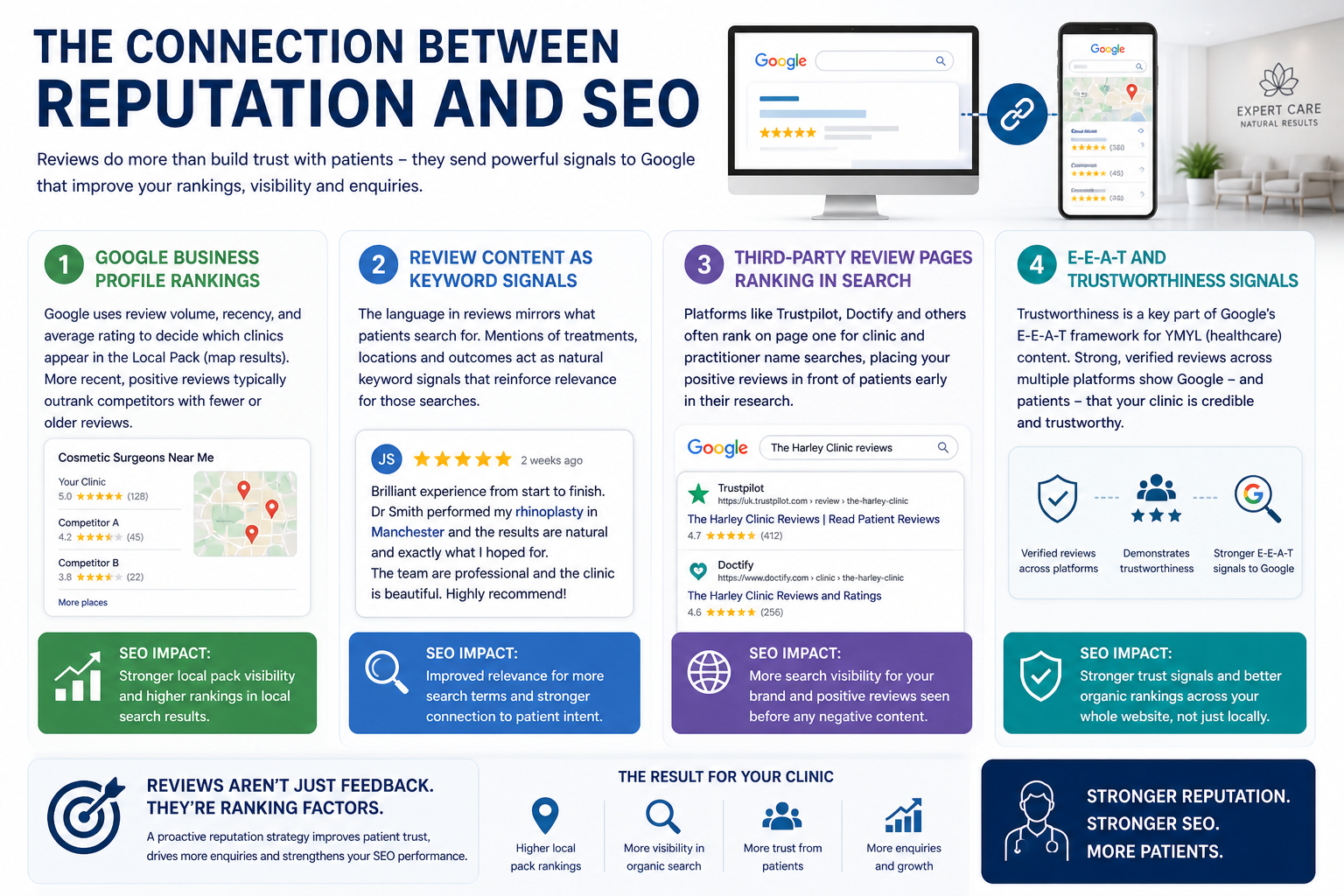
The Connection Between Reputation and SEO
Online reputation and search engine optimisation are more closely linked than most clinic owners appreciate. Review signals influence search rankings in several ways.
Google Business Profile rankings
Google uses review volume, recency, and average rating as factors in determining which clinics appear in the local pack, the map-based results that appear at the top of local searches. A clinic with a higher volume of recent, positive reviews will typically outrank a competitor with fewer or older reviews, all else being equal. This makes review generation a direct contributor to local SEO performance.
Review content as keyword signals
The language patients use in reviews often reflects the search terms they used to find the clinic. Reviews that mention specific procedures, locations, and outcomes contain natural keyword signals that reinforce the relevance of your Google Business Profile for those searches. Encouraging detailed reviews, rather than just star ratings, therefore has SEO value as well as conversion value.
Third-party review pages ranking in search
Trustpilot, Doctify, and similar platforms frequently rank on the first page of Google for clinic and practitioner name searches. A strong profile on these platforms means that even patients who search specifically for your clinic will encounter positive reviews before they find any negative content. This makes third-party review management an important part of overall healthcare digital marketing strategy.
E-E-A-T and trustworthiness signals
As noted earlier, Google’s E-E-A-T framework for YMYL content includes trustworthiness as a key dimension. A clinic with a strong, verified review profile across multiple platforms is demonstrating trustworthiness in a way that Google can observe and factor into how it evaluates the clinic’s content. This benefits organic rankings across the whole website, not just local search.
 Reputation Management and Paid Advertising
Online reputation also affects the performance of healthcare PPC campaigns. Patients who click a Google Ad and then search for reviews before enquiring, which many do, will encounter your review profile as part of that process. A strong reputation increases the conversion rate of paid traffic. A weak or mixed reputation undermines it.
Google Ads also allows advertisers to display seller ratings, a feature that shows your average review score directly within the ad. For clinics with strong review profiles, this can meaningfully increase click-through rates by providing social proof at the point of search. Enabling this feature requires a minimum number of reviews on qualifying platforms, which is another reason to prioritise systematic review generation.
Furthermore, reputation affects the performance of healthcare landing pages. Embedding verified reviews and review platform badges on landing pages increases trust and improves conversion rates from both paid and organic traffic.
Building a Reputation Management System for Your Clinic
Effective reputation management is not a one-off project. It is an ongoing system that becomes part of how the clinic operates. The following elements make up a functional reputation management system for a private healthcare clinic.
- A review request process: A consistent, systematic approach to asking every patient for a review at the right moment in their journey, with direct links to priority review platforms.
- Monitoring and alerts: A system for tracking new reviews across all platforms as they are posted, so responses can be made promptly and issues identified quickly.
- Response templates and guidelines: Pre-approved response frameworks for both positive and negative reviews, ensuring consistency and compliance with confidentiality obligations.
- Escalation process: A clear internal process for handling complaints that arrive via reviews, including who is responsible, how the resolution is documented, and when removal requests are appropriate.
- Regular reporting: Monthly review of review volume, average rating, platform distribution, and any patterns in negative feedback that may indicate a service issue requiring internal attention.
- Integration with marketing: Review content fed into website content, landing pages, and social media to maximise the visibility of positive patient experiences.
What Nexus Healthcare’s Reputation Management Service Covers
Nexus Healthcare provides complaint and reputation management as part of our digital marketing services for private healthcare providers. Our approach covers the full reputation management cycle, from building review volume to handling complaints professionally and integrating reputation signals into the broader digital marketing strategy.
We work with private clinics, consultants, and multi-location healthcare providers to build review profiles that support both patient acquisition and search visibility. Our approach is always aligned with the wider healthcare digital marketing strategy for each client, so reputation management works alongside SEO, PPC, and content rather than in isolation.
FAQs: Reputation Management for Private Clinics
How many reviews does a private clinic need?
There is no fixed minimum, but volume matters in several ways. Google uses review volume as a local ranking signal, so more reviews generally support better visibility in local search. For patient confidence, a clinic with fewer than 20 reviews will typically convert prospective patients at a lower rate than one with 50 or more. The goal should be continuous growth rather than reaching a fixed number, with new reviews added regularly to maintain recency signals.
Can I ask patients to leave reviews?
Yes, in most cases. Google’s guidelines permit businesses to ask customers to leave reviews, provided the request does not include incentives or require the patient to leave a positive review specifically. Healthcare-specific platforms such as Doctify and iWantGreatCare have their own invitation processes. In all cases, the request must be genuine and must not pressure the patient in any way.
What should I do if a review is false or defamatory?
Most review platforms have a process for flagging and requesting removal of reviews that violate their content policies, including reviews that are demonstrably false, relate to a different business, or contain inappropriate content. The process varies by platform and is not guaranteed to result in removal. In cases of potentially defamatory content, seeking legal advice is appropriate. For ongoing support with complex cases, our complaint and reputation management service can help.
How do I respond to a negative review without breaching patient confidentiality?
Keep responses general and avoid confirming, adding to, or referencing any clinical details mentioned in the review. Acknowledge the patient’s experience empathetically, express that their feedback is taken seriously, and invite them to contact the clinic directly to discuss the matter further. This approach demonstrates professionalism without creating a confidentiality risk.
Does reputation management affect SEO?
Yes, directly. Review volume and recency are factors in Google’s local ranking algorithm. Review content contains keyword signals that reinforce search relevance. Third-party review pages frequently rank for clinic name searches. And trustworthiness, which is partly demonstrated by a strong review profile, is a component of Google’s E-E-A-T framework for YMYL content. Managing reputation proactively therefore has measurable SEO benefits alongside the direct impact on patient acquisition.
How long does it take to improve an online reputation?
With a consistent review generation process in place, most clinics begin to see meaningful improvement in their review volume and average rating within two to three months. Building a profile strong enough to meaningfully influence local search rankings typically takes six to twelve months of sustained activity. Addressing a significantly damaged reputation, such as one with a prominent cluster of negative reviews, takes longer and may require a combination of review generation, complaint resolution, and in some cases content strategy to improve the overall picture a patient finds when they search.
Ready to Take Control of Your Clinic’s Online Reputation?
Nexus Healthcare provides specialist complaint and reputation management for private healthcare clinics across the UK. We help clinics build strong, verified review profiles, handle negative feedback professionally, and integrate reputation signals into a wider digital marketing strategy that drives sustainable patient acquisition.
If your clinic’s online reputation is not working as hard as it should be, get in touch with the Nexus Healthcare team to discuss how we can help.
