The Traffic Problem Nobody Talks About
Most private clinic owners focus almost entirely on getting more traffic.
More clicks. More visits. More people landing on the site.
But traffic is only half the equation.
If visitors are arriving and leaving without making an enquiry, the problem is not your SEO.
The problem is your website.
This is one of the most common and costly issues in private healthcare marketing. Clinics invest in Google Ads, SEO campaigns, and social media, drive meaningful traffic to their site, and then watch their enquiry rate flatline.
Understanding why that happens, and how to fix it, is the difference between a clinic that grows and one that stays stuck.
Why Clinic Website Traffic Does Not Always Convert
Before you can fix a conversion problem, you need to understand what is causing it.
In private healthcare, the reasons visitors do not convert are almost always one of the following.
1. The Website Does Not Build Enough Trust, Fast Enough
Private healthcare is a high-consideration decision. Patients are not browsing casually. They are weighing up whether they can trust you with something personal, sometimes significant, and always important to them.
If your website does not immediately communicate credibility, most visitors will leave within seconds. Not because your clinic is not excellent. But because your website has not given them the evidence to believe it.
Trust signals that most clinic websites are missing include:
- Named, qualified clinicians with visible credentials and professional biographies
- Real patient testimonials with enough detail to feel genuine
- Registration and accreditation information displayed prominently
- Professional photography showing your actual clinic and team
- Clear indications of how long you have been established
- Media coverage or professional memberships where relevant
Stock photography, generic copy, and anonymous branding actively erode trust. Patients can detect inauthenticity quickly, particularly when they are making a health decision.
This is why professional healthcare branding and creative media is not a cosmetic exercise. It is a conversion tool.
2. The Call to Action Is Unclear or Buried
Every page of your website should make it obvious what the visitor should do next.
In many clinic websites, calls to action are either vague, inconsistent, or only appear at the very bottom of the page after the visitor has already lost interest.
Common call to action failures include:
- Using generic text like ‘Contact us’ with no indication of what happens next
- Placing the phone number only in the footer
- Having no booking form or enquiry form visible above the fold
- Not differentiating between types of enquiry, for example, a consultation versus a general question
- Making the next step feel effortful or uncertain
A well-constructed call to action should tell the visitor exactly what they will get, how quickly, and how easy it is to take that step. Something as specific as ‘Book a free 15-minute consultation’ outperforms ‘Get in touch’ in almost every test.
Every page, from your homepage to your individual treatment pages, should have a clear, prominent, and repeated invitation to take action.
3. The Website Is Too Slow on Mobile
More than half of all healthcare searches now happen on a mobile device. If your clinic website takes more than three seconds to load on a smartphone, a significant proportion of your visitors will leave before the page has finished loading.
Page speed is not just a technical issue. It is a conversion issue and a ranking issue.
Google factors page speed into search rankings, meaning a slow site hurts your visibility before visitors even arrive. And once they do arrive, a sluggish experience immediately signals a lack of professionalism.
Speed problems are particularly common in WordPress-based clinic sites that have accumulated plugins, uncompressed images, and poor hosting over time.
A properly structured and maintained healthcare website should score consistently well on Google’s Core Web Vitals, especially on mobile.
4. The Content Answers the Wrong Questions
Most clinic websites are written from the clinic’s perspective. They talk about the practice, the equipment, the approach, and the team.
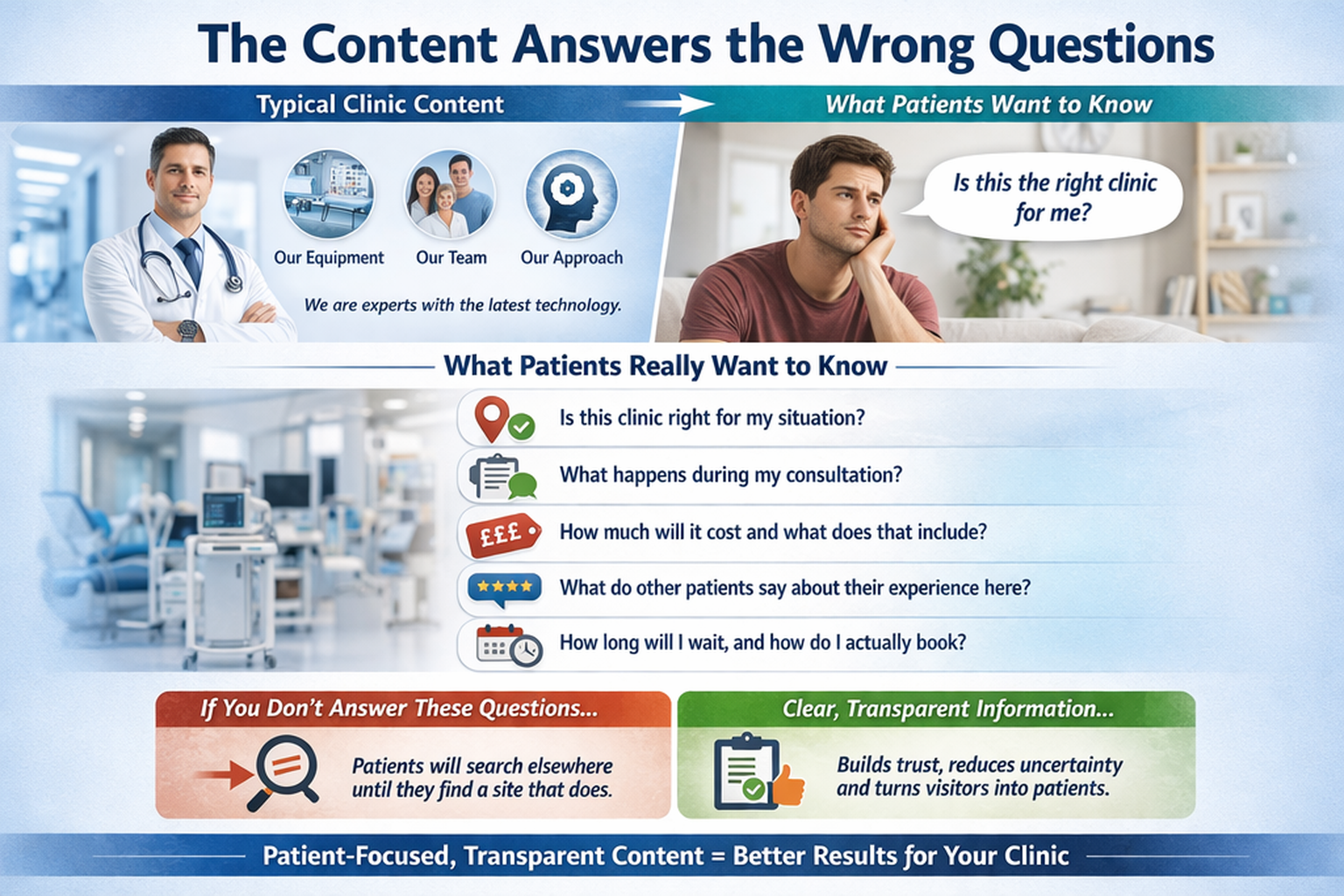 Patients arrive with a completely different set of questions in their minds.
They want to know:
- Is this clinic right for my specific situation?
- What will actually happen during my consultation?
- How much will it cost and what does that include?
- What do other patients say about their experience here?
- How long will I wait, and how do I actually book?
If your content does not address these questions directly and honestly, patients will search elsewhere until they find a site that does.
Pricing in particular is a consistent conversion barrier. Many private clinics are reluctant to publish costs, but the research consistently shows that patients respond more positively to transparent pricing, or at least a clear indication of the price range, than to being asked to enquire to find out.
Well-structured, patient-centred content, produced with the right balance of clinical accuracy and accessibility, is core to what we deliver through healthcare SEO at Nexus Healthcare.
5. The Booking or Enquiry Process Has Too Much Friction
Even when a visitor is ready to enquire, the process of actually doing so can lose them.
Common friction points include:
- Long contact forms asking for excessive information upfront
- Forms that are not mobile-optimised and difficult to complete on a phone
- No confirmation of when or how the clinic will respond
- Phone numbers that are hard to find or only available during restricted hours
- No live chat or WhatsApp option for patients who prefer not to call
The more steps you ask a patient to take before they feel they have made contact, the more opportunity there is for them to change their mind. Reducing friction is not about removing important information. It is about removing unnecessary barriers.
A simple, prominent enquiry form with two or three fields, a reassuring confirmation message, and a clear response time expectation will consistently outperform a comprehensive form that feels like a job application.
6. The Website Does Not Address Patient Anxiety
Many patients searching for private healthcare are anxious. They may be dealing with a health concern they have been putting off, considering an elective procedure they feel uncertain about, or returning to a type of treatment after a previous negative experience.
Websites that do not acknowledge this anxiety miss a critical conversion opportunity.
Content that genuinely addresses patient concerns, explains what to expect, introduces the team in a warm and accessible way, and makes the process feel manageable converts at a far higher rate than content that simply lists services and credentials.
Patient testimonials and case studies are particularly powerful here. They help a prospective patient see themselves in the experience of someone who felt the same uncertainty and made the same decision.
This is also where reputation management intersects with conversion. A strong review profile, integrated into your website and easy to find, can directly influence enquiry rates.
7. There Is No Clear Patient Journey Through the Site
Many clinic websites are built as a collection of pages rather than as a guided journey. Visitors land on a page, find some information, and then face a dead end with no clear path forward.
A website that converts should guide the visitor logically from awareness to action.
That means:
- Homepage clearly establishing what you do, who you serve, and why patients choose you
- Treatment pages that explain the procedure, the benefits, the process, and what happens next
- A team page that builds personal connection with the clinicians who will treat them
- Patient stories or testimonials that provide social proof at key decision moments
- A consultation page that removes all uncertainty about the booking process
Internal linking between these pages, when done thoughtfully, keeps visitors engaged and moves them progressively closer to making an enquiry.
This kind of structural thinking is embedded into how we approach healthcare website creation and management at Nexus Healthcare.
How to Diagnose and Fix Your Clinic’s Conversion Problem
If any of the issues above sound familiar, the good news is that conversion problems are fixable. And unlike SEO, which takes months to show results, conversion rate improvements can have an immediate impact on enquiry volumes.
Here is where to start.
Review Your Analytics Data
Google Analytics will tell you which pages have the highest exit rates, how long visitors are spending on each page, and where they are dropping out before reaching your contact page. This data points directly to where your conversion problems are concentrated.
If visitors are consistently leaving from a particular treatment page, the problem is likely in the content or the lack of a clear next step. If they are reaching your contact page but not completing the form, the form itself is the issue.
Test Your Website on a Mobile Device
Open your website on your own smartphone and attempt to make an enquiry as if you were a new patient. Notice how long it takes to load. Notice how easy it is to find your phone number. Notice whether the enquiry form is straightforward to complete. You will likely find problems you were not aware of.
Read Your Website as a Patient Would
Read your homepage and your top three treatment pages from the perspective of someone who knows nothing about your clinic. Ask yourself whether those pages clearly answer the questions that a patient in their situation would have. Ask whether they make you feel confident and reassured. Ask whether the next step is obvious.
If the honest answer to any of those questions is no, you have found a conversion barrier.
Add or Improve Your Trust Signals
If your website lacks testimonials, accreditations, named clinicians, or professional photography, addressing this should be a priority. These are not enhancements. In private healthcare, they are conversion essentials.
Simplify Your Enquiry Process
Review every step a patient must take from arriving on your website to making contact. Remove any step that is not strictly necessary. Make the enquiry form shorter. Add a phone number to the top of every page. Consider adding a WhatsApp contact option if your patient demographic would use it.
How Nexus Healthcare Can Help
At Nexus Healthcare, we work with private clinics, cosmetic practices, and healthcare providers across the UK to turn underperforming websites into consistent sources of patient enquiries.
Our approach is not just about design. It is about understanding the patient journey, identifying the specific barriers preventing visitors from converting, and building websites and content that address those barriers systematically.
We bring together:
- Healthcare SEO to ensure the right patients are finding you in the first place
- Healthcare website design and management built around patient psychology and conversion principles
- Digital creative solutions including professional photography, videography, and content that builds genuine trust
- Reputation and complaint management to ensure your review profile reinforces patient confidence
Whether the problem is your website structure, your content, your speed, or your calls to action, we can identify it and fix it.
Ready to Turn More Visitors Into Patients?
If your clinic is attracting traffic but not seeing the enquiry volumes you expect, the solution is closer than you think.
Contact us at Nexus Healthcare for a free consultation. We will review your website, identify the specific barriers preventing conversions, and give you a clear picture of what needs to change.
More visitors are already finding you. Let us make sure they are actually booking.
FAQs: Private Clinic Website Conversion
1. Why is my clinic website getting traffic but no enquiries?
There are several common causes. The most frequent are a lack of trust signals such as visible credentials, patient testimonials, and professional photography; unclear or absent calls to action; slow page load times on mobile; content that does not answer the questions patients are actually asking; and an enquiry process with too many steps. Often it is a combination of these factors rather than a single issue.
2. How long does it take to improve website conversion rates?
Unlike SEO, which can take months to show results in search rankings, conversion rate improvements can have an immediate impact. Changes such as adding a prominent enquiry form, improving trust signals, and simplifying the booking process can increase enquiry volumes within days of implementation. Structural content improvements typically take a few weeks to plan and execute but begin delivering results quickly once live.
3. Do I need a completely new website to improve conversions?
Not necessarily. Many conversion problems can be addressed by improving existing pages rather than rebuilding the entire site. However, if your website has fundamental structural problems, is running on outdated technology, or does not reflect the quality of your practice, a rebuild is often the most efficient solution in the long run.
4. How important is mobile optimisation for a private clinic website?
It is essential. The majority of healthcare searches now happen on mobile devices, and Google uses mobile page performance as a primary ranking factor. If your website is slow or difficult to use on a smartphone, you are losing both visibility and enquiries. Every element of a modern clinic website, from the enquiry form to the navigation to the page load speed, should be optimised for mobile first.
5. What is the most important trust signal on a clinic website?
Research consistently shows that named, credentialed clinicians are the most powerful trust signal on a private clinic website. Patients want to know who will be treating them before they book. A clinician biography page with a professional photograph, full qualifications, professional memberships, and a brief personal statement converts significantly better than an anonymous ‘our team’ page. Patient testimonials are the next most important, particularly when they are specific about the condition treated, the experience, and the outcome.
6. Should I publish pricing on my clinic website?
In most cases, yes. Patients searching for private healthcare are aware they will be paying out of pocket, and price transparency is increasingly expected. Websites that include a clear indication of treatment costs, or at minimum a starting from price and what is included, tend to convert at a higher rate than those that require patients to enquire before they can find out. If your pricing is genuinely variable and difficult to publish, a clear explanation of the factors that affect cost, combined with an offer of a free initial consultation, can serve a similar function.
7. How do patient reviews affect website conversion rates?
Significantly. A strong review profile, displayed prominently on your website, directly increases the likelihood that a visitor will make an enquiry. Patients treat reviews as peer-to-peer evidence of the quality of your care, which carries far more weight than anything you can say about yourself. Actively managing your review profile and integrating those reviews into your website, rather than linking out to external platforms, is one of the highest-return activities a private clinic can undertake.
8. What is the best call to action for a private clinic website?
The most effective calls to action for private clinic websites are specific, low-commitment, and benefit-led. Rather than ‘Contact us’, something like ‘Book your free 15-minute consultation’ or ‘Speak to a member of our team today’ gives the visitor a clear picture of what happens next and reduces the perceived risk of taking that step. The call to action should appear multiple times on each page, including above the fold on your most important pages, and should be visually distinct from the surrounding content.
