

Introduction
When a patient needs a GP, dermatologist, or cosmetic consultation, they do not ask around first.
They go to Google and search:
clinic near me
That moment is high intent, immediate, and local. And it is exactly where Healthcare SEO makes the biggest impact.
For private clinics across the UK, visibility in Google Maps is not just helpful. It is often the difference between a steady stream of enquiries and an empty appointment book.
The clinics that appear in the Map Pack, the top three listings, consistently attract more calls, more bookings, and more high value patients, while those that do not are rarely considered.
Local Healthcare SEO is about ensuring your clinic shows up at the exact moment patients are ready to choose. When done properly, it becomes one of the most reliable and cost effective growth channels available. If you want a broader view of how this fits into your overall strategy, our guide to healthcare SEO for private clinics explains how search drives long term patient growth.
Why Google Maps Is Critical for Healthcare SEO
Patient behaviour has fundamentally changed.
Healthcare decisions are now:
- Mobile first
- Search driven
- Location based
Google Maps sits at the centre of all three.
 Before a patient ever visits your website, they see your reviews, your rating, your location, and your competitors. That first impression often determines whether they click or move on, which is why Healthcare SEO at a local level has such a direct impact on enquiries.
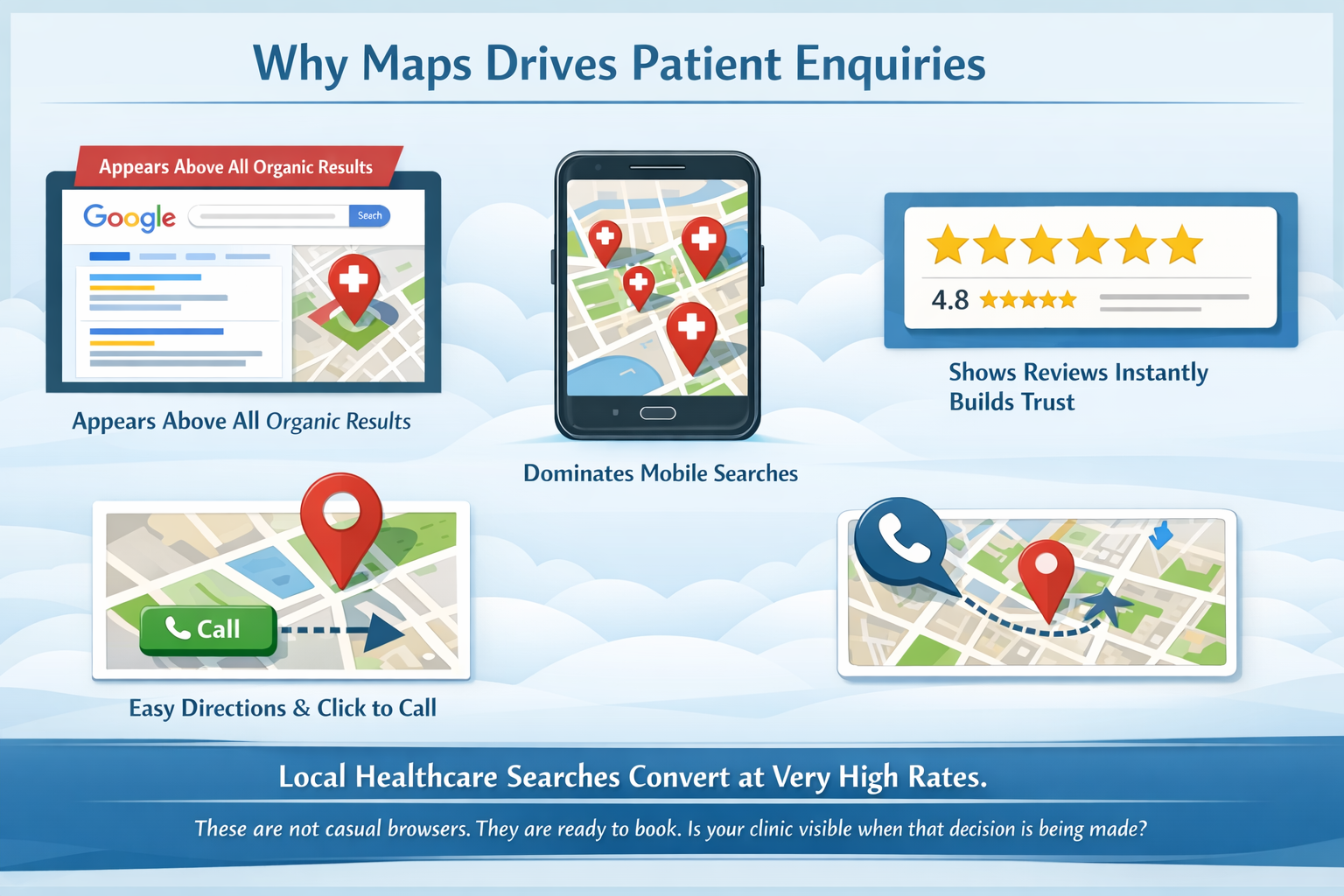
Why Maps drives patient enquiries
- It appears above all organic search results
- It dominates mobile healthcare searches
- It shows reviews instantly, which builds trust
- It removes friction with directions and click to call
Local healthcare searches convert at very high rates. These are not casual browsers. They are ready to book. The key question is whether your clinic is visible when that decision is being made.
Optimise Your Google Business Profile
Your Google Business Profile is the foundation of your local Healthcare SEO.
Many clinics set it up once, leave it incomplete, and never optimise it properly. This is one of the most common reasons clinics fail to rank, and it is often one of the first areas we improve when working with new clients.
Accurate Business Information
Your clinic name, address, and phone number must be completely consistent everywhere online.
Even small inconsistencies such as St versus Street can weaken trust signals in Google. These issues are easy to miss internally but can significantly impact rankings if left unresolved.
Choosing the Right Categories
Your primary category is one of the strongest ranking signals.
Examples include:
- Private Medical Clinic
- General Practitioner
- Cosmetic Clinic
- Physiotherapist
You can also add secondary categories to reflect additional services, which helps Google better understand the full scope of your clinic.
Adding Services with Keywords
Use real search terms when listing services:
- Private GP appointments
- Dermatology consultations
- Health screening
- Weight management clinic
These act as keyword signals for Google and help match your profile to relevant searches. Most clinics either skip this or do it incorrectly, which limits visibility.
Photos and Visual Content
Google favours active profiles.
Adding high quality images of your clinic exterior, reception area, consultation rooms, and team helps build trust before a patient ever makes contact. Profiles with strong visuals consistently receive more engagement, which is why visual presentation plays such a key role in Healthcare SEO. If you want to see how this influences patient perception, our article on why branding, videography and design matter in healthcare explores this in more detail.
Posts and Updates
Use the Posts feature to share updates, services, and health tips.
Regular activity signals to Google that your profile is maintained, which can support your visibility over time.
Get More Patient Reviews
Reviews are one of the most important ranking and conversion factors in Healthcare SEO.
What matters most:
- Volume
- Recency
- Responses
A clinic with a steady stream of recent reviews will almost always outperform one with similar ratings but no recent activity.
How to Ask for Reviews Effectively
The most effective approach is to systemise it.
This can include asking at reception, sending follow up messages, or using automated tools to request feedback shortly after appointments. Clinics that rely on occasional requests typically struggle to build consistent review momentum.
Responding to Reviews
Responding to every review shows both Google and prospective patients that you take feedback seriously.
For negative reviews, it is important to acknowledge concerns professionally and move the conversation offline where possible. Managing this well can actually improve trust rather than damage it. If this is an area you want to strengthen, our complaint and reputation management service is designed specifically for healthcare providers.
Build Local Citations
Citations are mentions of your clinic name, address, and phone number across the web, and they act as a key trust signal in Healthcare SEO.
Important sources include platforms such as Doctify, Top Doctors, WhatClinic, Yell, and Thomson Local. The challenge is not just getting listed, but maintaining complete consistency across every listing, which becomes increasingly difficult as your online presence grows.
Optimise Your Website for Healthcare SEO
Your website and your Google Business Profile are closely linked in how Google evaluates your clinic.
A strong profile with a weak website limits your overall performance. If your current site is not structured with search in mind, our healthcare website design and management service focuses on building sites that both convert patients and support SEO.
Location Pages
Creating strong location signals is essential.
If you operate from a single location, your site should clearly reflect that. If you have multiple locations, each should have its own dedicated page with unique content, accurate details, and local relevance.
Local Keywords
Use natural, patient focused phrases such as private GP in London or cosmetic clinic Birmingham.
The goal is to reflect how real patients search, rather than forcing keywords unnaturally into your content.
Schema Markup
LocalBusiness schema helps search engines understand your clinic in a structured way.
While relatively simple for a developer to implement, it is often missing or incorrectly configured, which can limit your visibility in local results.
Internal Linking
Connecting your blog content, service pages, and location pages through internal links helps reinforce your Healthcare SEO structure and improves how Google understands your site.
Use Local Content Marketing to Build Authority
Content is where Healthcare SEO and trust come together.
Google increasingly prioritises content that demonstrates genuine expertise and credibility, particularly in healthcare.
Content Ideas That Work
- Private GP Services in London What to Expect
- Common Skin Conditions Treated in Manchester Clinics
- Health Checks Before Summer in Birmingham
Add Clinical Credibility
Content should be written or reviewed by qualified clinicians wherever possible, with clear author bios and credentials included.
This strengthens trust with both search engines and patients. It also plays a growing role in newer search experiences, which is why our article on why most private clinics are invisible in AI search is worth reading alongside this.
Build Local Backlinks
Backlinks remain a strong ranking factor in Healthcare SEO.
Local and relevant links from news sites, healthcare partners, and professional organisations carry the most weight. A small number of high quality links will often outperform a large number of low quality ones. For a deeper look at how this fits into a wider strategy, our healthcare SEO services guide breaks this down further.
Common Healthcare SEO Mistakes
We regularly see clinics held back by:
- Inconsistent NAP information
- No structured review process
- Poorly optimised Google Business Profile
- Weak or duplicated location pages
- Lack of internal linking
- No local backlinks
Addressing these issues alone can lead to noticeable improvements in visibility and enquiries.
Track Your Google Maps Rankings
Healthcare SEO is not something you set up once and leave.
Monitoring performance through tools like Google Business Profile Insights and Google Search Console helps you understand what is working and where opportunities exist. Many clinics do not track this effectively, which makes it difficult to improve results over time.
Conclusion
Healthcare SEO is one of the most effective ways to grow a private clinic.
It builds long term visibility, strengthens patient trust, and creates a consistent flow of enquiries without relying entirely on paid advertising.
The clinics that succeed are those that invest consistently in their online presence and treat local SEO as a core part of their growth strategy.
Want to Improve Your Rankings and Patient Enquiries
If you have read this and realised your clinic is not doing all of this properly, you are not alone.
Most clinics implement parts of Healthcare SEO but never see the full benefit because key elements are missing or inconsistent.
At Nexus Healthcare, we specialise in Healthcare SEO and digital marketing for private clinics across the UK, combining technical optimisation with a deep understanding of patient behaviour.
If you are ready to improve your visibility in Google Maps and attract more patients, you can get in touch with our team here to discuss how we can help your clinic grow.
Frequently Asked Questions About Local SEO
1. What is local SEO for private clinics?
Local SEO for private clinics is the process of optimising your online presence so your clinic appears in local search results, especially in Google Maps. It helps attract nearby patients actively searching for services like GP appointments, dermatology, or cosmetic treatments.
2. How do private clinics rank in Google Maps?
Private clinics rank in Google Maps by optimising their Google Business Profile, building consistent local citations, collecting patient reviews, and improving their website’s local SEO. Proximity, relevance, and prominence are the key ranking factors.
3. Why is Google Maps important for private clinics?
Google Maps is often the first thing patients see when searching for a clinic. Listings in the Map Pack receive the highest visibility, leading to more calls, website visits, and appointment bookings compared to standard search results.
4. How many reviews does a clinic need to rank well locally?
There is no fixed number, but clinics with a steady flow of recent, high-quality reviews tend to rank higher. Consistency, recency, and engagement (responding to reviews) matter more than just total volume.
5. What are local citations and why do they matter?
Local citations are online mentions of your clinic’s name, address, and phone number. They help Google verify your business information and improve trust, which supports higher rankings in local search results.
6. How long does local SEO take to work for a private clinic?
Local SEO typically takes 3 to 6 months to show meaningful improvements, depending on competition and current visibility. However, optimising your Google Business Profile and generating reviews can produce quicker wins.
