

For healthcare providers, a website is not just a marketing asset.
It is an extension of clinical credibility, patient trust and professional responsibility.
Patients now form opinions about a clinic long before a consultation takes place. In many cases, your website is the first interaction someone has with your practice. It shapes whether they feel confident enough to enquire, book, or even trust the care you provide.
Yet many healthcare websites are still built using generic design templates, standard SEO tactics and management models that fail to reflect the realities of regulated, trust-led clinical environments.
This article explores what makes healthcare websites fundamentally different, why design and management choices matter more in this sector, and how clinics can create a digital presence that genuinely supports patient decision-making. For more insights on healthcare digital strategy, see our blog hub for healthcare businesses.
Healthcare Websites Are Evaluated Differently by Patients
 Healthcare decisions are rarely impulsive.
Unlike retail or lifestyle services, patients tend to approach clinics cautiously, looking for reassurance, clarity and professionalism before taking action.
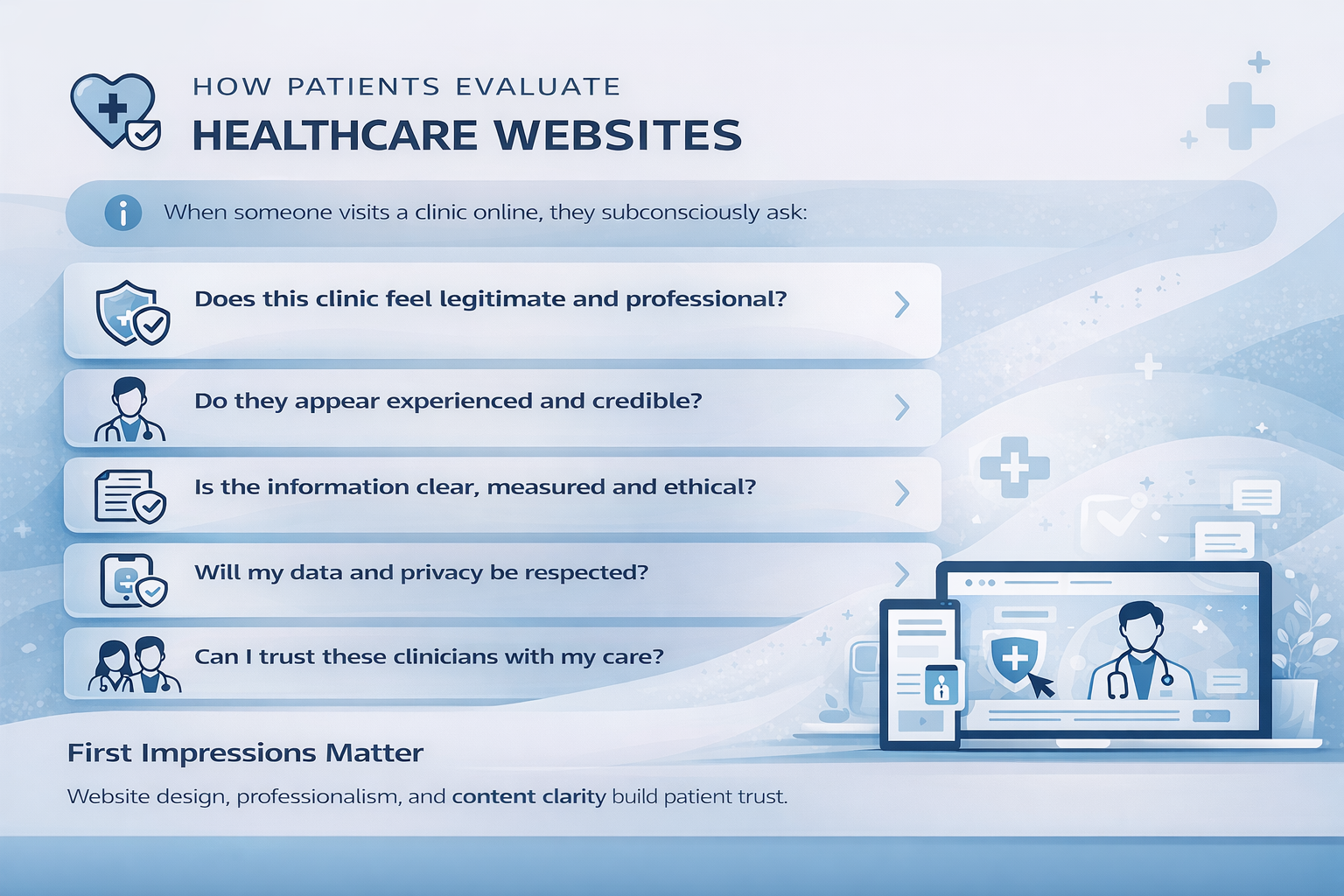
When someone lands on a healthcare website, they are subconsciously asking:
- Does this clinic feel legitimate and professional?
- Do they appear experienced and credible?
- Is the information clear, measured and ethical?
- Will my data and privacy be respected?
- Can I trust these clinicians with my care?
Design choices, tone of voice, structure and page flow all contribute to how those questions are answered.
A visually impressive website that lacks clarity or feels overly sales-driven can undermine trust just as quickly as a poorly designed one. If you have questions about how a healthcare website should function, our FAQs section offers concise answers to common concerns.
Why Generic Website Design Often Fails Healthcare Providers
Many clinics inherit websites built on general business templates. While these may look modern on the surface, they often fall short in key areas that matter specifically to healthcare.
Common issues include:
- Overuse of promotional language that feels inappropriate in a clinical context
- Poor mobile usability for patients searching on phones
- Weak page structure that confuses users and search engines
- Inadequate consideration of privacy, accessibility or compliance
- Little thought given to how patients actually make decisions
Healthcare websites require a more considered approach, one that balances visual professionalism with restraint, accuracy and usability.
If you’d like to explore related topics and trends, browse our range of healthcare insights and strategy articles.
Trust, Not Transactions, Should Guide Website Structure
One of the biggest differences between healthcare websites and other sectors is user intent.
Most visitors are not looking to make an immediate decision. They are looking to understand, evaluate and feel reassured.
Effective healthcare websites are therefore structured around:
- Clear explanations rather than persuasive sales copy
- Logical navigation that reduces cognitive load
- Calm, professional layouts that mirror clinical environments
- Content that supports informed decision-making
This does not mean avoiding conversion altogether. It means designing enquiry pathways that feel appropriate, measured and patient-centred.
The Role of SEO in Healthcare Is Subtler Than Many Realise
Search engine optimisation is essential for healthcare visibility, but aggressive or keyword-heavy SEO can be counterproductive.
Modern healthcare SEO works best when it is:
- Embedded naturally into content structure
- Aligned with how patients phrase questions
- Focused on clarity, relevance and authority
- Supported by clean technical foundations
Search engines, and increasingly AI-driven search tools, now prioritise content quality, intent alignment and expertise signals over mechanical keyword tactics.
For clinics, this means SEO should feel invisible to patients while still performing effectively behind the scenes.
AI Search Is Changing How Healthcare Content Is Discovered
AI-assisted search tools are reshaping how patients find and interpret healthcare information online.
 Rather than ranking only entire pages, these systems increasingly extract and summarise specific passages that clearly answer questions.
Healthcare websites that perform well in AI search tend to:
- Use clear, declarative headings
- Answer patient questions directly
- Group related topics logically
- Avoid ambiguity or exaggerated claims
This places even greater importance on content structure and clarity, not just keyword placement.
Why WordPress Remains a Strong Foundation for Clinics
For most healthcare providers, WordPress continues to offer a practical balance of flexibility, stability and long-term control.
From a clinic perspective, this matters because it allows:
- Ownership of content without vendor lock-in
- Ongoing security and platform updates
- Easy content editing by non-technical teams
- Scalability as services, locations or teams grow
When configured correctly, WordPress also supports performance optimisation, accessibility improvements and structured data. All are important considerations in healthcare environments.
Mobile Experience Is No Longer Optional in Healthcare
A significant proportion of patients now access healthcare websites via mobile devices, often during moments of urgency or uncertainty.
Poor mobile experiences can erode trust instantly.
Healthcare websites must ensure:
- Text is readable without zooming
- Navigation is simple and intuitive
- Contact and enquiry actions are easy to find
- Pages load quickly on mobile networks
Mobile optimisation is not just about convenience. It directly impacts whether patients feel supported or frustrated.
Different Clinics Need Different Website Structures
Not all healthcare providers need the same type of website.
The most effective structure depends on the clinic’s size, services and growth plans.
For example:
- A new or niche clinic may benefit from a focused, single-page layout
- A multiservice practice often requires a structured, brochure-style site
- Established clinics may need deeper content, analytics and optimisation capabilities
- Practices offering online services or products require secure transactional functionality
The key is alignment between clinical reality and digital structure, rather than forcing all clinics into a single model.
Ongoing Website Management Matters More in Healthcare
Unlike static brochure sites, healthcare websites require continuous attention.
Regular management helps ensure:
- Security updates are applied promptly
- Performance remains stable and reliable
- Content stays accurate and current
- Technical issues are resolved before affecting patients
From a patient perspective, broken pages or outdated information can quickly undermine confidence.
From a clinic perspective, proactive management reduces risk and internal workload.
Compliance, Accessibility and Ethical Communication
Healthcare websites operate in a more regulated and ethically sensitive space than many other industries.
This includes considerations around:
- GDPR and data handling
- Accessibility for diverse users
- Appropriate medical language and claims
- Transparency and patient protection
Design and content decisions must reflect these responsibilities without becoming restrictive or impersonal.
When Is It Time to Rethink a Healthcare Website?
Many clinics tolerate underperforming websites longer than they should, often because the risks feel unclear.
A review is usually worthwhile if your website:
- Feels outdated or difficult to update
- Does not reflect the quality of care you provide
- Generates low-quality or inconsistent enquiries
- Is hard for patients to navigate on mobile
- Lacks clarity around services or next steps
In many cases, improvement does not require a full rebuild. It does require a structured, informed assessment.
A Strategic Approach Makes the Difference
The most effective healthcare websites are not the most visually dramatic or heavily marketed.
They are the ones that quietly:
- Build confidence
- Communicate professionalism
- Support patient understanding
- Reflect clinical values
- Perform reliably over time
If you’d like to explore related services or consult with the team, the resources linked above can help you navigate your next steps.
Final Thought
In healthcare, your website is part of your care pathway.
When designed and managed with intent, it supports trust, reduces friction and helps patients feel confident taking the next step.
If your digital presence no longer reflects the standard of care you provide, taking a closer look is often the most responsible place to start.
Frequently Asked Questions About Healthcare Websites
What makes a healthcare website different from a standard business website?
A healthcare website is designed to support trust, clarity and ethical communication rather than direct sales. Patients often arrive with uncertainty or concern, so the website must prioritise professionalism, accuracy, accessibility and reassurance. Healthcare websites also operate within regulated environments, requiring careful consideration of privacy, compliance and appropriate language.
How important is website design for patient trust?
Website design directly influences whether patients perceive a clinic as credible and professional. Visual layout, typography, structure and imagery all contribute to first impressions. A clear, calm and well-organised design helps patients feel reassured, while cluttered or overly promotional designs can reduce confidence and discourage enquiries.
Should healthcare websites focus more on information or conversions?
Healthcare websites should focus primarily on supporting patient understanding. Clear information, thoughtful structure and measured tone help patients evaluate services and feel confident. Conversion elements such as enquiry forms should be integrated naturally and appropriately, rather than positioned as aggressive sales prompts.
Is SEO really necessary for healthcare websites?
Yes. SEO helps healthcare websites appear when patients search for clinics, services or information. Effective healthcare SEO focuses on clarity, relevance and authority rather than heavy keyword use. Content should reflect how patients naturally phrase questions and seek reassurance, while technical foundations support visibility and performance.
How does AI search affect healthcare website content?
AI search tools prioritise content that clearly answers specific questions. Healthcare websites perform better in AI search when content is well structured, uses clear headings and provides concise, accurate explanations. This makes clarity and intent alignment more important than keyword density or promotional language.
Why is mobile optimisation so important for clinics?
Mobile optimisation ensures patients can easily access healthcare information on phones and tablets. Many patients search for clinics outside normal working hours or in urgent situations. A mobile-friendly website improves readability, navigation and access to contact details, supporting trust and reducing frustration.
Do healthcare websites need ongoing maintenance?
Yes. Ongoing maintenance is essential to keep healthcare websites secure, reliable and accurate. Regular updates help prevent security issues, maintain performance and ensure content reflects current services and information. Poorly maintained websites can undermine patient trust and create unnecessary risk.
How often should a healthcare website be reviewed or updated?
Most healthcare websites benefit from a formal review at least once per year. Smaller updates should be made whenever services, regulations, team details or patient expectations change. Regular reviews help ensure the website remains accurate, professional and aligned with the clinic’s standards of care.
Can an existing healthcare website be improved without a full rebuild?
Yes. Many healthcare websites can be improved through better structure, updated content, performance optimisation or clearer patient journeys. A structured review helps determine whether targeted improvements or a full rebuild will provide the greatest long-term value.
What should clinics consider before investing in a new website?
Clinics should consider how the website supports patient trust, clarity and long-term growth. Key factors include usability, mobile experience, compliance awareness, content quality and ongoing management. A healthcare website should be treated as a long-term clinical asset rather than a short-term marketing project.
