

Why Healthcare SEO Is No Longer Optional
The way patients find healthcare has changed permanently. In the not-too-distant past, word of mouth, Yellow Pages listings, and proximity to a bus route were sufficient to keep an appointment book full. Today, the journey begins online. Research consistently shows that the vast majority of patients, across every demographic, use search engines to locate healthcare providers, investigate symptoms, compare treatment options, and evaluate the reputation of a clinic before ever picking up the phone.
For doctors, clinics, and hospitals, this shift presents both a challenge and an extraordinary opportunity. The challenge: if your practice is not visible in search results, you are effectively invisible to a growing proportion of your potential patient population. The opportunity: a well-executed medical SEO strategy, one built around how patients actually search, can deliver a sustained, compounding return on investment that outperforms almost every other marketing channel available to a healthcare provider.
This article explains what healthcare SEO is, why it matters, what measurable benefits it delivers, and how to evaluate its return on investment. Whether you are a GP principal, a hospital marketing director, or the administrator of a specialist clinic, understanding healthcare search engine optimisation is now a core professional competency.
Patients who find your practice through organic search are already motivated. They searched for exactly what you offer. That intent-driven traffic is among the most valuable any business can acquire.
What Is Healthcare SEO?
Search engine optimisation for healthcare, variously referred to as medical SEO, healthcare search engine marketing, or SEO for medical websites, is the discipline of improving the visibility of a healthcare provider’s website and online presence in the unpaid (organic) results of search engines such as Google and Bing.
Unlike paid advertising (PPC), where you pay per click and visibility ceases the moment budget is paused, organic search optimisation builds a durable asset. A well-optimised healthcare website continues to attract patients around the clock, without an ongoing per-visit cost.
Healthcare SEO encompasses several interconnected disciplines:
- Technical SEO, ensuring that search engines can crawl, index, and understand your website’s structure, speed, and security.
- On-page SEO, optimising the content, headings, metadata, and internal linking of individual pages around the terms patients use to search.
- Local SEO, securing prominence in location-based searches such as ‘GP near me’ or ‘physiotherapist in Edinburgh’, including management of your Google Business Profile. See our guide to SEO for physiotherapy clinics for a specialty-specific example.
- Content marketing, publishing clinically accurate, authoritative articles and guides that answer the questions patients are asking at every stage of their health journey.
- Off-page SEO and link building, earning citations and backlinks from reputable medical directories, journals, and news outlets to strengthen your site’s authority.
- Reputation management, actively managing reviews on Google, NHS choices, and other platforms, which directly influence both search rankings and patient trust. Our complaint and reputation management service supports healthcare providers in this area.
The Scale of the Opportunity: How Patients Search
Understanding the volume and intent behind healthcare search queries is essential to appreciating why medical SEO investment is justified. Consider the data that informs the keyword landscape:
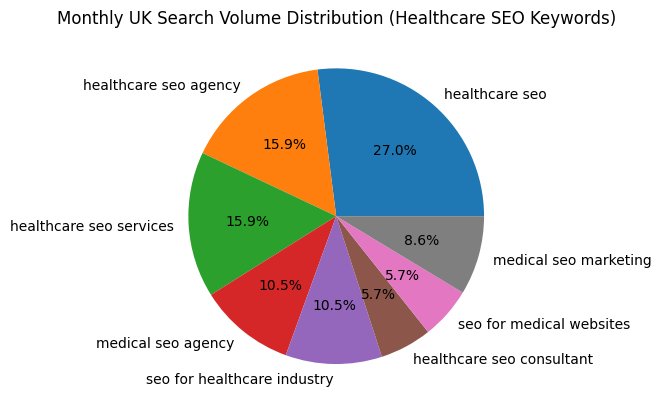
| Keyword / Search Query | Monthly UK Search Volume |
| healthcare seo | 1,000 |
| healthcare seo agency | 590 |
| healthcare seo services | 590 |
| medical seo agency | 390 |
| seo for healthcare industry | 390 |
| healthcare seo consultant | 210 |
| seo for medical websites | 210 |
| medical seo marketing | 320 |
These are searches conducted by healthcare organisations looking for SEO support, a proxy for the enormous patient-facing search demand that makes those services commercially important in the first place. Patient-facing queries around symptoms, treatments, and ‘doctor near me’ type searches dwarf these numbers by several orders of magnitude.
Google’s own health data indicates that health-related searches are among the most frequent performed on its platform globally. As explored in our blog post Why Healthcare Providers Can’t Afford to Ignore SEO in 2026, patient search behaviour has shifted decisively online and shows no signs of reversing.
Every day that a well-funded competitor outranks your practice for the terms your prospective patients are searching is a day of patient acquisition lost, often permanently, given the loyalty patients typically show once they register with a provider.
YMYL and E-E-A-T: Why Google Holds Healthcare Content to a Higher Standard
Healthcare content sits within what Google classifies as ‘Your Money or Your Life’ (YMYL), a category of topics where inaccurate, misleading, or low-quality information could directly harm a reader’s health, financial wellbeing, or safety. YMYL status has profound implications for how healthcare websites are evaluated and ranked.
Google applies its most rigorous quality standards to YMYL content. A page written by an anonymous author, citing no clinical sources, and making unsubstantiated claims about a treatment will not rank well against a page that is clearly authored by a qualified clinician, supported by peer-reviewed evidence, and presented on a site with clear professional credentials. This is not a recent development. It has been a central pillar of Google’s search quality guidelines for several years and has intensified with successive core algorithm updates.
What YMYL Means in Practice
For healthcare providers, YMYL classification affects every piece of content published on your website, from service descriptions and treatment pages to blog articles and FAQs. The practical implications are as follows:
- Content accuracy is non-negotiable. Any claim about symptoms, treatments, outcomes, or clinical guidance must be medically accurate and, where appropriate, referenced to authoritative sources such as NICE guidelines, NHS resources, or peer-reviewed journals.
- Author credentials must be visible. Google evaluates who wrote or reviewed a piece of content. Pages that display the name, qualifications, and professional registration of the clinician or medical reviewer who authored or approved the content perform significantly better in YMYL assessments.
- Site-level trustworthiness matters. The reputation of the overall domain, including its about page, team profiles, professional accreditations, and regulatory registrations, contributes to how individual pages are assessed. A CQC-registered provider that displays its registration openly signals trustworthiness.
- Patient reviews and third-party validation carry weight. Independently verified reviews, professional body memberships, and media coverage all contribute to the off-site signals that support YMYL content evaluation.
- Content must be kept current. Out-of-date clinical information is a YMYL risk. Protocols, guidelines, and treatment options change; a page referencing superseded guidance can actively harm rankings and, more importantly, patients.
E-E-A-T: The Quality Framework for Healthcare SEO
YMYL operates in conjunction with Google’s E-E-A-T framework: Experience, Expertise, Authoritativeness, and Trustworthiness. These are not ranking factors in the traditional sense; they are quality signals that Google’s algorithms and human quality raters use to assess whether a page deserves to rank for health-related queries.
- Experience refers to first-hand involvement with the subject matter. For healthcare, this means content that reflects genuine clinical practice, written or reviewed by practitioners who work with patients, not merely with information.
- Expertise is the depth of knowledge demonstrated. A consultant cardiologist writing about atrial fibrillation, or a dental surgeon writing about implant procedures, brings a level of expertise that generalist content writers cannot replicate.
- Authoritativeness is earned through recognition from peers and reputable organisations. Links from medical journals, citations in NHS guidance, or coverage in credible healthcare publications all contribute to authoritative status.
- Trustworthiness encompasses transparency, accuracy, and the absence of misleading content. For healthcare providers, this means clear disclosure of fees, realistic presentation of treatment outcomes, and honest communication about risks.
Building E-E-A-T into a healthcare website requires a coordinated approach, combining clinical content production, professional author attribution, technical site integrity, and reputation management. Our specialist healthcare SEO services are structured around these principles, ensuring that every element of your online presence supports Google’s quality assessment rather than undermining it.
Why YMYL Makes Professional Healthcare SEO Non-Negotiable
The YMYL framework is the reason that generic SEO agencies, even competent ones, often struggle to deliver results for healthcare clients. The standards required go beyond keyword research and link building. They require a genuine understanding of clinical accuracy, regulatory compliance, patient communication, and the specific signals that Google uses to evaluate health content. This is explored in more depth in our blog post Why Healthcare Websites Need a Different Approach to Design, SEO and Management.
For healthcare providers, the message is clear: investing in YMYL-compliant, E-E-A-T-optimised content is not optional. It is the baseline requirement for organic search visibility in a competitive healthcare market. Providers that treat their website as a brochure, populated with thin, unattributed content, will find it progressively harder to rank as Google’s quality thresholds continue to rise.
The Core Benefits of Healthcare SEO
1. Sustainable Patient Acquisition
The most fundamental benefit of SEO for healthcare providers is a reliable, ongoing flow of new patient enquiries. Unlike a paid advertising campaign that delivers results only while active, a strong organic search presence compounds over time. Pages that rank well continue to attract patients months and years after the initial investment in their optimisation.
For a GP surgery, this might mean appearing prominently when someone moves to the area and searches for a new practice. For a private clinic, it means being found by patients who have just received a referral and are researching their options. Our guide to SEO for private clinics in the UK sets out in detail how this patient acquisition engine is built.
2. Reaching Patients at the Point of Intent
Search engine optimisation is unique among marketing channels because it intercepts patients at the exact moment they are expressing a need. A patient searching ‘private dermatologist Edinburgh’ is not idly browsing. They have a problem and are actively looking for a solution. Appearing prominently for that search places your practice in front of a prospective patient at the highest-value moment in their decision-making journey.
This intent-driven quality of organic search traffic is what makes it so commercially powerful. Conversion rates from organic search, meaning the proportion of visitors who go on to book an appointment or make an enquiry, consistently outperform display advertising and social media traffic in healthcare contexts.
3. Building Long-Term Authority and Trust
As outlined in the YMYL section above, Google’s approach to healthcare content is shaped by E-E-A-T. A healthcare SEO strategy built on clinically accurate, professionally authored content does more than improve rankings. It positions your organisation as a trusted authority. When patients read genuinely helpful, expertly written content on your website, whether about managing a chronic condition, understanding a procedure, or knowing when to seek urgent care, they form a positive association with your brand before they have even made contact.
That trust is extraordinarily difficult for competitors to replicate quickly and is one of the most durable competitive advantages a healthcare provider can build. It also extends to AI-powered search: as we discuss in Why Most Private Clinics Are Invisible in AI Search, the organisations that will be cited by AI search tools are those that have built genuine authority through consistent, high-quality content.
4. Competitive Differentiation
In most UK cities and many regional markets, the competition for private patients, and the competition for NHS list registrations, is intensifying. A healthcare SEO firm or specialist healthcare SEO agency working on your behalf can conduct thorough competitive analysis, identifying where rivals are outranking you and the specific keyword gaps and content opportunities that represent your fastest route to improved visibility.
Practices that invest in medical SEO services early tend to build a compounding advantage: higher rankings lead to more traffic, which generates more patient reviews and brand mentions, which further strengthens rankings. Those who delay cede ground that becomes progressively harder to recover.
5. Cost Efficiency Compared to Paid Advertising
Pay-per-click advertising in healthcare is among the most expensive in any sector. Google Ads for medical and healthcare keywords can carry a cost-per-click well above industry averages, reflecting the high commercial value of the underlying patient acquisition. While PPC has its place, particularly for new services or time-sensitive campaigns, it is not a sustainable standalone strategy for patient acquisition.
In contrast, the cost per patient acquired through organic search typically falls significantly as a well-optimised site matures. The initial investment in healthcare search engine marketing is front-loaded; the ongoing cost of maintaining and incrementally improving rankings is considerably lower than maintaining equivalent visibility through paid channels. This makes SEO for medical sites one of the highest-return long-term marketing investments available to healthcare organisations.
6. Enhanced Local Visibility
For the majority of healthcare providers, GP surgeries, dental practices, physiotherapy clinics, optometrists, and similar, the relevant patient population is geographically defined. Health care SEO with a strong local focus ensures that your practice appears prominently in the ‘local pack’ (the map results that appear at the top of location-based searches) as well as in the broader organic results.
Optimising your Google Business Profile, securing consistent Name-Address-Phone (NAP) citations across health directories, and building localised content are all components of effective local healthcare SEO. Our specialty-specific guides to SEO for dental practices, SEO for fertility clinics, and SEO for aesthetic clinics demonstrate how local visibility strategies are tailored to different practice types.
7. Improved Patient Experience and Engagement
A well-executed healthcare website SEO strategy is not merely about rankings, it is about creating a better experience for patients at every touchpoint. Technical SEO improvements (faster page loads, mobile optimisation, cleaner navigation) directly improve the experience of every visitor. Healthcare website design and SEO are deeply interconnected; a site that is technically excellent but poorly structured will underperform both in rankings and in patient satisfaction.
The visual and brand dimensions of patient experience are equally important, as we discuss in Why Branding, Videography and Design Matter More Than Ever in Healthcare. Our creative media and branding services are designed to ensure that the quality of your online presence reflects the quality of the care you provide.
Measuring ROI: A Framework for Healthcare Providers
One of the most common questions from healthcare providers considering investment in medical SEO marketing is how to measure the return. Unlike a Google Ads campaign where cost and conversion data are directly available, organic search ROI requires a slightly more structured measurement approach, but it is entirely achievable.
Step 1: Establish Baseline Metrics
Before any SEO activity commences, document your current position: organic search traffic volume, rankings for your target keywords, number of enquiries or bookings attributable to organic search, and your website’s conversion rate (the proportion of organic visitors who make contact or book).
Step 2: Define and Track Conversions
A ‘conversion’ in healthcare SEO terms is typically one of the following: a new patient registration form submitted, a telephone enquiry tracked via a call tracking number, an online appointment booking, or a contact form submission. Modern analytics platforms, primarily Google Analytics 4, enable these conversions to be attributed to organic search with reasonable precision.
Step 3: Calculate Cost Per Acquisition
With conversion tracking in place, you can calculate the cost per patient acquired through organic search by dividing total SEO investment (agency fees, content production, technical work) by the number of conversions attributable to organic search. As a mature SEO programme accumulates rankings, this cost per acquisition typically decreases year-on-year, the defining characteristic of organic search as a marketing channel.
Step 4: Calculate Patient Lifetime Value
Healthcare is characterised by high patient lifetime value. A patient who registers with a GP practice may remain registered for a decade or more. A patient who has a positive experience at a private clinic is likely to return for follow-up consultations and to refer family members and colleagues. When calculating the ROI of healthcare SEO investment, lifetime value rather than single-visit revenue is the appropriate denominator.
A conservative example illustrates the point: if a healthcare SEO investment of £2,000 per month generates 20 new patient enquiries per month, and 15 of those convert to registered patients with an average lifetime value of £500, the monthly patient lifetime value generated is £7,500, a return of 3.75x on the SEO investment. In specialties with higher procedure values, the return can be dramatically higher.
| ROI Metric | Example Value |
| Monthly SEO investment | £2,000 |
| New enquiries from organic search | 20 / month |
| Conversion rate to patient | 75% |
| Average patient lifetime value | £500 |
| Monthly lifetime value generated | £7,500 |
| Return on Investment | 3.75x |
Choosing the Right Healthcare SEO Partner
Given the regulatory complexity, YMYL requirements, and reputational sensitivity of the healthcare sector, selecting a healthcare SEO agency or healthcare SEO consultant requires careful evaluation. Not all SEO practitioners have the domain knowledge necessary to operate effectively in a medical context.
What to Look For
- Demonstrated experience with healthcare clients and familiarity with CQC, ASA, and MHRA content guidelines where applicable.
- A content production process that involves qualified clinical oversight or medical editorial review, essential for YMYL compliance.
- Transparent reporting against agreed KPIs, including organic traffic, rankings, and attributable conversions.
- An approach grounded in Google’s E-E-A-T guidelines, avoiding tactics that could expose your practice to algorithmic penalties.
- A clear understanding of local SEO for healthcare, including Google Business Profile optimisation and healthcare directory management.
- Capability across the full digital marketing spectrum, from SEO to PPC, website management, and reputation management, so that your various channels are coordinated rather than operating in silos.
Healthcare SEO in the UK
The UK healthcare market presents specific SEO considerations. The presence of the NHS means that patient search behaviour is shaped by the availability of free-at-point-of-use care. Private healthcare providers must therefore position their SEO content around the genuine differentiators of private care: speed of access, choice of consultant, enhanced facilities, and continuity of care. Our detailed guide to healthcare SEO services for clinics and hospitals covers these considerations in detail.
For NHS provider organisations, healthcare SEO serves a different purpose: reducing pressure on telephone lines and reception staff by ensuring that patients can self-serve information about services, opening hours, and referral pathways. The ROI in this context is measured in staff time saved and patient satisfaction scores rather than revenue generated.
Common Mistakes Healthcare Providers Make with SEO
Understanding what not to do is as important as knowing what to do. The following are the most common errors made by healthcare organisations when approaching medical practice search engine optimisation:
- Treating SEO as a one-time project rather than an ongoing programme. Search is dynamic; competitors are continuously improving their positions, and Google updates its algorithms regularly.
- Producing content without clinical accuracy checks. In healthcare, inaccurate content does not merely damage rankings, it can cause patient harm and attract regulatory scrutiny. This is the core implication of YMYL classification.
- Ignoring local SEO. For the majority of healthcare providers, local visibility is more commercially valuable than national visibility. Specialty-specific local SEO strategies are discussed in our guides to SEO for dental practices and SEO for physiotherapy clinics.
- Neglecting mobile optimisation. The majority of health-related searches are now conducted on mobile devices. A site that delivers a poor mobile experience will underperform in rankings and in conversion rates.
- Failing to manage patient reviews. Reviews are a significant factor in local SEO rankings and a primary driver of patient trust. Our complaint and reputation management service ensures that your review profile is actively managed and that any concerns are handled in a way that protects your reputation.
- Choosing an SEO partner without healthcare sector expertise. Generic SEO tactics applied to a medical website can create YMYL compliance risks and may fail to address the specific E-E-A-T signals that Google evaluates for health content.
The Future of Healthcare SEO
The healthcare SEO landscape is evolving rapidly, shaped by several converging trends that providers and their marketing teams should monitor closely.
AI and Search Generative Experience
Google’s integration of AI-generated summaries into search results will alter how patients interact with health information. Providers whose content is cited as a source in AI-generated summaries will gain significant brand exposure. This makes the production of authoritative, well-cited YMYL-compliant clinical content more important than ever, not less. Our analysis in Why Most Private Clinics Are Invisible in AI Search sets out exactly what healthcare providers need to do to remain visible in this rapidly changing landscape.
Voice Search and Conversational Queries
The proliferation of smart speakers and voice assistants is shifting search patterns towards longer, more conversational queries. Healthcare SEO for medical websites that is structured around natural question-and-answer formats will be better positioned to capture this traffic as it grows.
Video and Visual Search
Patients are increasingly turning to video content for health information. Healthcare providers who invest in well-produced, clinically accurate video content will access a growing segment of health searchers who prefer this format. This is one of the reasons why professional healthcare videography and branding are increasingly integral to an effective SEO strategy, rather than being treated as separate creative exercises.
Hyper-Local and Near-Me Searches
As mobile search behaviour becomes more sophisticated, hyper-local queries (‘urgent care open now’, ‘walk-in GP near me’) are growing in volume. Healthcare organisations that invest in comprehensive local SEO, including real-time information about availability and wait times, will be well positioned to capitalise on this trend.
Conclusion: SEO as a Strategic Asset for Healthcare Providers
Healthcare SEO is not a peripheral marketing activity. For any healthcare organisation that depends on patient acquisition, whether private or NHS, primary or secondary, generalist or specialist, it is a core strategic investment that directly affects revenue, reputation, and the ability to serve more patients effectively.
The benefits are well-documented: sustainable patient acquisition, intent-driven traffic, long-term authority building, competitive differentiation, and a cost efficiency that paid advertising cannot match at scale. YMYL compliance and E-E-A-T optimisation are not additional burdens, they are the framework that makes healthcare SEO work at the level of quality that patients and search engines both demand.
Selecting the right healthcare SEO agency is a decision that deserves the same rigour applied to any significant clinical or operational procurement. The risks of poor execution are real, but so are the rewards of getting it right.
In a healthcare market where patient choice is expanding and digital-first behaviour is now the norm across all age groups, the question is no longer whether to invest in SEO. It is whether to act early enough to build a sustainable competitive advantage. To explore what that looks like for your organisation, book a free consultation with the Nexus Healthcare team today.
The best time to invest in healthcare SEO is now.
This article has been produced by Nexus Healthcare for informational purposes. Healthcare organisations should ensure all SEO content complies with relevant regulatory frameworks including ASA, CQC, and MHRA guidelines.
