
AI Search Has Already Changed Patient Acquisition
Most private clinics believe they are competing for Google rankings.
They are not.
They are competing for inclusion in AI-generated answers.
When a patient searches:
- “Best knee surgeon near me”
- “Private MRI scan London”
- “Top ADHD assessment clinic UK”
They are increasingly shown summarised recommendations; not a list of websites.
If your clinic is not structured for extraction, it will not be referenced.
If it is not referenced, it does not exist.
This is why modern Healthcare SEO is no longer about rankings alone, it is about structured authority.
The Shift: Rankings Matter. Extraction Matters More.
AI-driven search compresses the research journey.
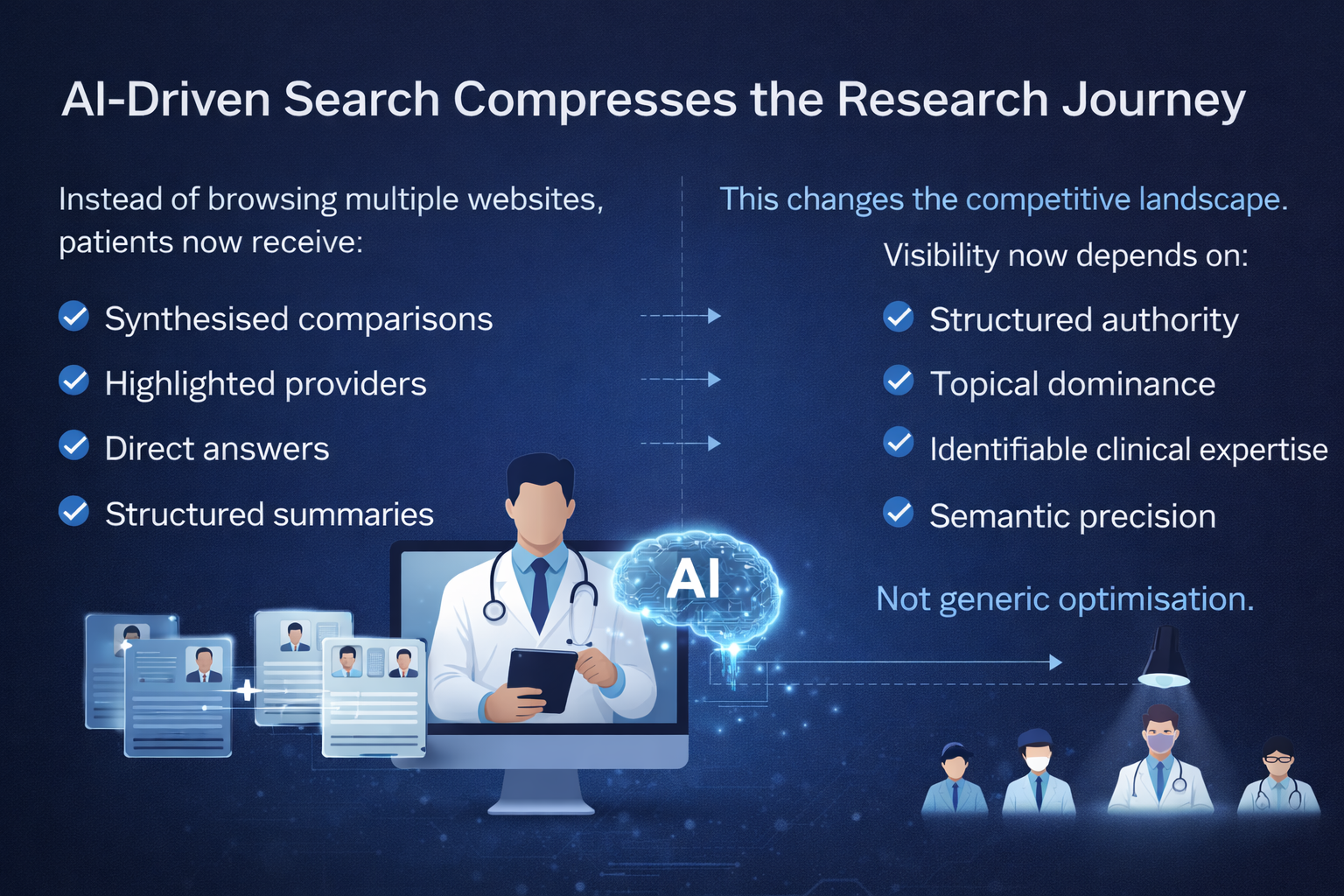 Instead of browsing multiple websites, patients now receive:
- Synthesised comparisons
- Highlighted providers
- Direct answers
- Structured summaries
This changes the competitive landscape.
Visibility now depends on:
- Structured authority
- Topical dominance
- Identifiable clinical expertise
- Semantic precision
Not generic optimisation.
This evolution sits at the intersection of advanced Digital Marketing for Healthcare and authority-led search strategy.
Why Most Private Clinics Are Invisible
1. Their Websites Are Built for Design, Not Authority
Clean design is not strategy.
Most clinic websites lack:
- Clear procedural depth
- Structured expertise signals
- Extractable FAQs
- Consistent terminology
AI systems cannot summarise what is vague.
Vague content gets ignored.
True visibility starts with strategic Website Creation and Management built around extractability not just aesthetics.
2. They Confuse “Having a Page” With Having Authority
One service page does not create dominance.
AI systems assess:
- Topic clusters
- Supporting content
- Internal reinforcement
- Expertise alignment
- Contextual depth
If your knee surgery page stands alone, it will not compete with a structured ecosystem.
Authority is layered. Not declared.
For clinics looking to understand how this works in practice, our guide to SEO for Private Clinics in the UK outlines the structural approach required.
3. Clinical Expertise Is Not Structurally Obvious
AI tools prioritise identifiable experts.
Most clinics fail to:
- Attribute content to named clinicians
- Reinforce specialisation consistently
- Structure credentials clearly
- Connect expertise across related procedures
Anonymous marketing copy does not build confidence.
And AI favours confidence.
Strategic positioning of clinicians through intelligent Digital Creative Solutions strengthens both visibility and conversion.
4. There Is No Structured FAQ Architecture
AI heavily references question-led content.
Without:
- Clear question headings
- Concise, direct answers
- Commercially aligned FAQs
- Proper schema implementation
Your website becomes harder to interpret.
Hard to interpret means easy to exclude.
Structured FAQ architecture is now a core component of advanced Healthcare SEO strategy.
5. They Rely on Paid Ads to Mask Structural Weakness
Paid advertising can generate traffic.
It does not create authority.
When ad spend stops, visibility disappears.
AI search does not reward ad budgets.
It rewards structural credibility.
Long-term growth comes from integrated digital marketing systems, not isolated campaigns.
What AI Search Actually Rewards
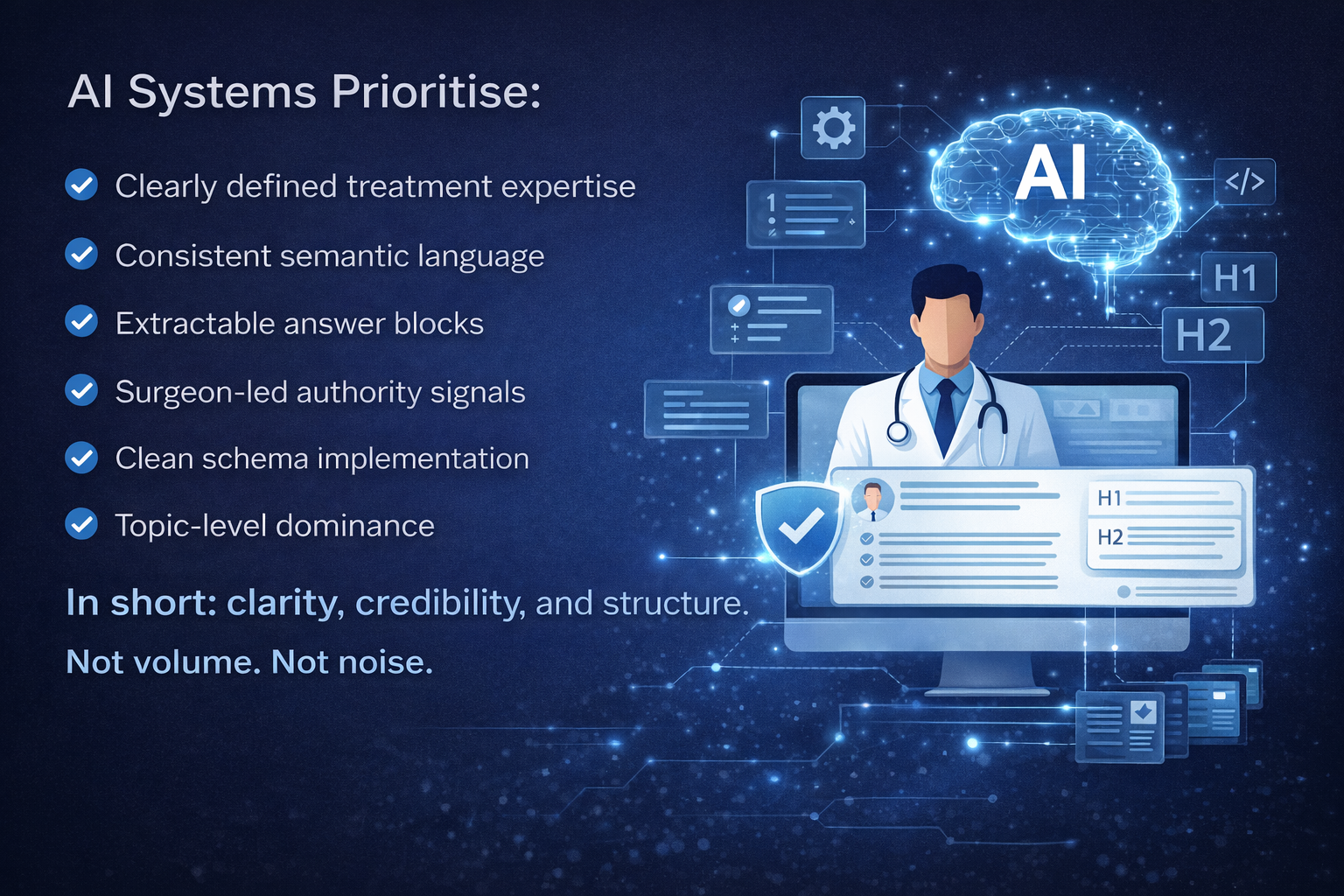 AI systems prioritise:
- Clearly defined treatment expertise
- Consistent semantic language
- Extractable answer blocks
- Surgeon-led authority signals
- Clean schema implementation
- Topic-level dominance
In short: clarity, credibility, and structure.
Not volume. Not noise.
How Private Clinics Fix AI Invisibility
1. Build Topic Ecosystems, Not Isolated Pages
Authority requires:
- Core procedure hubs
- Supporting condition pages
- Comparison content
- Revenue-aligned FAQs
- Expert commentary
This creates topical gravity.
AI systems favour depth.
2. Elevate Surgeon & Clinician Authority
Expertise must be unmistakable.
Strengthen:
- Biography pages
- Credentials and memberships
- Defined areas of specialisation
- Consistent terminology
- Structured data
When authority is explicit, inclusion increases.
3. Implement Structured FAQ Layers
Each high-value service page should include:
- 4–8 commercially relevant FAQs
- Direct, extractable answers
- Decision-stage queries
- FAQ schema
This dramatically increases citation potential.
4. Replace Generic Language With Precision
Avoid:
“We provide comprehensive solutions.”
Use:
“We provide private MRI scans in London with same-week appointments.”
Precision increases trust.
Trust increases extractability.
5. Align SEO With Revenue Drivers
Visibility should prioritise:
- High-margin procedures
- Underutilised capacity
- Competitive service lines
- Geographic expansion targets
SEO is not about traffic volume.
It is about revenue predictability.
Will AI Search Reduce Website Traffic?
It may reduce low-intent informational visits.
It often increases:
- Consultation-ready enquiries
- Commercially serious prospects
- Brand authority perception
Lower volume. Higher value.
That is the evolution.
The Commercial Risk of Inaction
Clinics that ignore AI-driven visibility risk:
- Reduced organic presence
- Rising acquisition costs
- Increased dependency on paid channels
- Loss of market authority
AI search is not a feature.
It is a structural shift.
Authority-Led SEO at Nexus Healthcare
Nexus Healthcare builds healthcare SEO strategies around structural authority and commercial performance.
We do not optimise for algorithms.
We engineer visibility systems aligned with revenue.
Our approach integrates:
- Authority-led content architecture
- AI extractability optimisation
- Surgeon positioning strategy
- Technical schema implementation
- Revenue-focused search mapping
The objective is not rankings.
The objective is sustained patient acquisition growth.
Final Word: Visibility Is Now Selective
Private clinics are no longer competing for clicks.
They are competing for inclusion.
If your clinic cannot be confidently summarised, it will not be referenced.
If it is not referenced, it will not be chosen.
AI search is accelerating.
The clinics that structure for authority now will own their category.
The rest will compete on ad spend.
Strategic Visibility Assessment
If you want to understand:
- Whether your clinic is AI-visible
- Where structural authority gaps exist
- Which procedures lack dominance
- How your competitors are positioned
You can contact Nexus Healthcare for a strategic visibility assessment tailored to private healthcare providers.
AI search is not a future concern.
It is already influencing patient decisions.
FAQs: AI Search & Private Clinic Visibility
1. Why is my private clinic not showing up in AI search results?
Most private clinics are invisible in AI search because their websites lack structured authority. AI systems prioritise clear expertise, structured FAQs, semantic clarity, and identifiable clinicians. If your content is generic, shallow, or not technically structured, AI tools are unlikely to reference it in summaries.
2. How can I tell if my clinic is visible in AI-generated answers?
You can test by searching your core procedures in conversational formats, such as “Who is the best private knee surgeon in London?” If your clinic is never referenced or reflected in summaries, it likely lacks extractable authority signals. Visibility depends on structure, not just rankings.
3. Does AI search replace traditional SEO for healthcare websites?
No. AI optimisation is an evolution of SEO, not a replacement. Traditional ranking factors still matter, but AI systems prioritise clarity, authority, and structured content. Clinics that combine technical SEO with semantic depth and expert positioning are more likely to appear in AI-generated summaries.
4. Can smaller specialist clinics compete with large hospital groups in AI search?
Yes, if their expertise is structured more clearly. AI search reduces brand bias and amplifies well-defined authority. Specialist clinics with focused procedure pages, strong clinician positioning, and structured FAQs can outperform larger competitors with generic content.
5. Will optimising for AI search increase patient enquiries?
When implemented correctly, yes. AI visibility often improves enquiry quality by attracting patients who are closer to booking. While overall traffic may not dramatically increase, the proportion of high-intent consultations typically improves.
6. What is the fastest way to improve AI visibility for a private clinic?
The fastest improvements usually come from restructuring high-value procedure pages. Adding commercially focused FAQs, strengthening clinician authority signals, improving semantic clarity, and implementing FAQ schema can significantly increase AI extractability within months.
7. How much revenue could my clinic be losing by not appearing in AI search?
If your clinic is absent from AI-generated recommendations, you are likely losing high-intent enquiries to competitors who are referenced. For high-value procedures, even a small drop in visibility can translate into significant monthly revenue loss. AI search is increasingly influencing early decision-making invisibility directly impacts patient acquisition.
8. Is AI search visibility more important than Google rankings now?
Rankings still matter, but AI inclusion is becoming equally critical. Being ranked on page one does not guarantee you will be summarised or recommended. Clinics structured for extractability and authority are more likely to be surfaced in AI-driven answers, which increasingly shape patient decisions.
9. How quickly can AI optimisation impact patient enquiries?
Structural improvements to high-value procedure pages can begin influencing visibility within a few months. While authority builds over time, clinics that implement structured FAQs, clinician positioning, and semantic optimisation often see improved enquiry quality within 3–6 months, depending on competition.
